


Every week in 2013, I’ll be sharing a different way you can save $100 this year. If you do all of these things, you’ll be able to save over $5,000 this year alone! Many of these things will likely be things you’re already doing, but hopefully all of you will pick up at least a few new ideas or some inspiration from this series.
One simple way to save $100 per year is by lowering your fuel costs. If you shave off just $3 in gasoline costs every week, that’s well over $100 in savings per year.
Here are some practical ways to consider lowering your fuel costs:
1. Have a cash budget for gas.
We used to always pay for gas with our debit card, but while we tried to stick with our allotted budget, we found it was easy to go a little over every month — especially with fluctuating gas prices. We switched to using cash only for gas last year and we’ve seen a decrease in our gas budget. Why? Because we are more mindful of our gas usage and because cash forces us to stick with our budget.
2. Buy lower-grade fuel.
Unless your vehicle requires higher grade fuel, there’s no need to spend the extra cents on it per gallon. While it might not seem like much, those extra cents add up quickly!
3. Observe the speed limit.
Each vehicle is different, but typically gas mileage plummets when you drive over 60 miles per hour. In fact, it’s estimated that for each five miles over 60 miles per hour you drive, it’s the equivalent of paying an additional $0.24 per gallon!
4. Combine errands.
Have a general rule of thumb that you won’t go out shopping or running errands unless you have at least three stops to make. Before you go, map out the most efficient route. Not only will this save you time, it will also lower your gasoline expenses. Plus, you’ll likely carefully consider whether or not that quick trip to the store for milk or bread is worth it or whether you can make-do with what you have on hand.
I’ve also found it helpful to limit errands and shopping to one or two days per week and to work errands or shopping trips into driving I’m already planning to do. For instance, if I’m going somewhere close to the health food store, I’m going to try and work in a stop there to save me making an extra trip later in the week. It only takes a little bit extra time and it costs me almost nothing in fuel since I’m already going to be driving by.
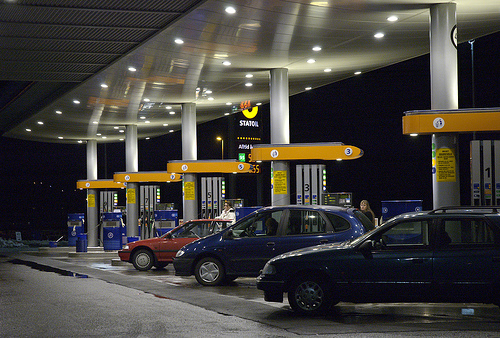
5. Drive a fuel-efficient vehicle.
If you have more than one vehicle in your household, use the vehicle with the highest miles per gallon as often as you can. According to FuelEconomy.gov:
A vehicle that gets 30 MPG will cost you $903 less to fuel each year than one that gets 20 MPG (assuming 15,000 miles of driving annually and a fuel cost of $3.61).
Over a period of 5 years, the 30-MPG vehicle will save you $4,515.
Planning to buy a car in the near future? Aid your decision-making by using the Fuel Cost Comparison Calculator.
6. Travel during non-peak hours.
As much as you possibly can, plan your trips when it’s non rush-hour traffic. You’ll get to your destination(s) more quickly and you’ll conserve gas.
7. Consider using public transportation.
While public transportation might not seem feasible for you, if gas is eating your budget alive, it’s worth checking into. According to a study by the American Public Transportation Association, you can save over $9,000 per year by using public transportation.
Of course, this number is going to be inflated for you if you don’t work outside the home and have a regular commute, however, it’s important to note that this figure was based on a $2.75 per gallon price. With most of us paying at least $3 to $4 per gallon, if you have a daily commute, the savings could even be higher than $9,000 per year if you use public transportation!
Find more ways to save on gasoline in this post.
How do you save money on gas?

 Read 3 chapters of