

Guest post from Jennifer
When I became a stay-at-home-mom, making the leap from two incomes to one was an adjustment to say the least — and my husband and I knew things had to change in order for us to make this work financially.
First and foremost, we knew we had to have a budget.
We discussed where our money should be going and, among other things, decided on a $75 per week grocery budget (his would also include all toiletries, diapers, wipes, etc.)
This was a great concept and I was excited to get started. I confess no actual budget was written down or reviewed each month, it was basically a verbal budget that I was “keeping track of” in my head.
Over time, we learned that verbal budgets don’t work and are a terrible and naive way of having a budget. Sadly, I didn’t realize this for a while!
Every week, I made two major grocery trips: one to Aldi and one to Walmart for price-matching. I told myself that as long as I spent between $25-$35 at each store we were doing good. Many times, I only spent $20-$30 at Aldi so I always thought I was being a good frugal stay-at-home mom.
The truth is, I never really counted the small trips to the Dollar Store, Target, or CVS since I would spend less than $10, and I was getting so much for so little with coupon stacking, and ECB’s. As long as I spent between $20-$35 on each of my big trips each week I was staying within my make-believe budget.
How silly is that concept?
Oh, and I didn’t mention our once to twice-a-month trip to Costco that was never put into my equation. Typing this makes me want to go back in time and slap some sense into myself!
Fast forward…
My husband and I decided that I needed to be the one that paid the bills and managed our finances. We do bill-pay with our bank and everything is set up through e-mail so this task isn’t very time consuming, but it was my turn to manage it all.
We also discussed another budget. You see, we couldn’t figure out where our money was going. Well, we could have by looking at our bank statements, but we never took the time to do so and actually see where we were spending our money.
Since I was deemed the new money manager, I decided it was time to break it all down and see why we weren’t putting money into savings each month. I was shocked, no blown away to see that my” $75 per week” grocery budget was main reason we weren’t saving any money.
In one month alone, I overspent by $260!
All those little trips to Target, the Dollar Tree and CVS added up quickly, to say the least.
This was more than a wake up call, this was an air horn blowing in my face telling me to wake up and take control of our money. Aha!
The real put-on-paper-and-be-accountable-for-our-money plan:
My husband gets paid on the 1st and 15th of every month, so we decided that we would start doing a cash withdrawal from each pay check of $150 for groceries. When I reviewed our bank statements, it was the 6th of the month and I found out I had already spent $130 of the $150 allocated for the first half of the month…yikes!
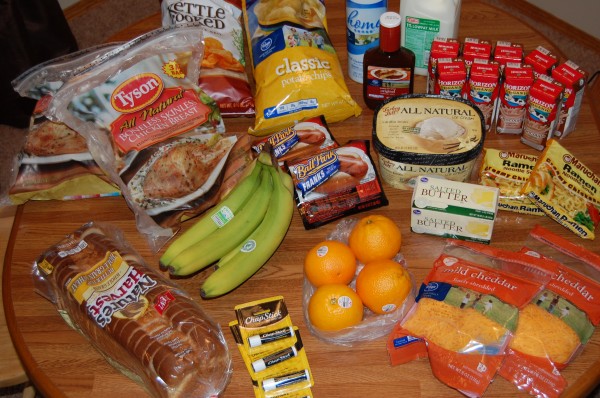
At this point, I was so disappointed in myself I decided to take the challenge of only spending $20 ($22.78 to be exact) over the next 9 days on groceries and toiletries, and school supplies for my preschooler.
What we did to make it work:
1. I made a meal plan with the food we already had.
I had been doing a weekly meal plan for some time, but it always included a grocery list of items I would have to get to make the meals. This time I made a plan with the food we already had on hand.
A crazy thought, huh? I was amazed to see what we had hiding in our freezers and pantry. I created new meals we never had before and made it work.
2. I saved leftovers and actually ate them!
In the past, I would save leftovers but then on trash day those good intentions went into the garbage. This time, we ate those leftovers.
I also saved food not eaten by my children that was still left on their plates and not touched (things like grapes and peas) and used them for another meal or for snacks. Normally, I would just throw the leftover food in the trash and not give in a second thought.
3. My husband and I drank less milk and soda and more water and tea.
Before, our family would easily go through 5 gallons of milk per week. We had a large glass of milk for every meal, and my kids love milk. That is why I didn’t mess with their milk intake.
I didn’t want to create unhealthy habits for the sake of saving money. However, my husband and I were drinking way above the amount that is recommended, so we cut it down and drank more water and tea.
4. I made food out of food.
Its a wild thought nowadays to make food from scratch… but it works!
I wanted to use a recipe that called for cream of chicken soup but we didn’t have cream of chicken soup. However, we did have all the ingredients needed to make it, and that’s what I did. It’s easy and straight forward.
5. I bought only what we needed for that week.
On the Sunday before my budget overview, our church message was about the Lords Prayer. The section that stuck with me was “Give us this day our daily bread…” Not our monthly bread or stockpile bread but our daily bread.
So often, I tend to stock up on items just because they are on sale, or a great deal with a coupon — and a stocked pantry or freezer is justification on why my grocery bills are larger than they needed to be, or why our savings account was dwindling. But, during these 9 days I took a hard look on what my family actually needed, and it was a lot less than I realized.
I’m not anti-stockpiles by any means, but for my family in this season of our lives, a fully funded savings account will do us more good than 25 boxes of Mac and Cheese. I do plan to take advantage of sales and use coupons on items as long as I can stay within my cash budget and be able to get what we need for that week.
6. I looked around the house for my child’s school supplies.
Thankfully, my oldest son is in preschool, so the supply list was pretty small. He already had a backpack from last year, and Toy Story doesn’t go out of style! I bought off-brand crayons and markers because he’s in preschool. I had a box of ziptop bags in my pantry, and a couple of glue sticks in my craft supplies.
Before my budget A-Ha moment, I would have easily spent $20 or more on school supplies, justifying it as necessary for school, and a one-time purchase. But since I put myself of a cash budget, I spent under $5 and my son still had everything he needed to learn his colors and letters.
7. We had fun with it.
My husband and I like to tease each other and have fun, and this situation was no exception. We didn’t stress out or become angry, we thought outside of the box and made it work.
We survived that 9 days with on $22.78, and on the 15th, I excitedly withdrew my $150 grocery budget for the second half of the month and bought milk immediately! I’m sort of kidding… but I AM happy to say that during the very first month of actually following our budget we were able to put over $300 into our savings account!
Going to a cash budget is hard and sometimes not so fun, especially when you have 3 days left until the next cash withdrawal and you’re counting coins to buy eggs and diapers.
We will have bumps along the way, and may have to dip into next month’s cash in order to buy deodorant. In the long run, though, when we have the savings we need to replace broken-down appliances, mend broken arms, or have a proper family vacation, the extra work and planning will be well worth it.
Jennifer Willis is a stay-at-home-mom of 2 boys. She’s married to her husband, John, and they live in Olathe, Ks.















 A testimony from Abbygail