

I’m wondering if your readers have any good info on reliable gift card exchange sites. An online search results in an overwhelming number of options, and as it seems like this would be an area with a lot of potential for fraud, I thought I’d check to see what you all might know about it! -Erin

Reader Tip: Unwanted Clothes + Consignment = More Space and $!
This is a great time of the year to clear the clutter in your closets!

Do you have clothes laying around your house that you haven’t worn in over a year? Maybe you’re more organized than that and have them in tubs or boxes but they’re just taking up space in your garage? Maybe you don’t know what to do with them and you hate garage sales. Don’t worry; there is a solution.

Consignment shops are stores that specialize in selling used clothing and occasionally other items, too. My guess is there’s probably one in your area somewhere. There are tons of them popping up ever since the economy slid downhill. What they do is take your unwanted clothing, display it in their store and give you a percentage of the profit if it sells! Sounds easy enough, right?
Every consignment shop is different and has its own rules and guidelines to follow. My suggestion would be to call around and ask what percentage they offer, what their requirements are and then compare them if you have more than one option.
Another good idea would be to visit the shop and check out their prices. See if you would be happy getting that amount for your clothing. Almost always your stuff will be marked higher than what you would mark it at a garage sale. So not only do you make more, you are also saved the time and energy that a garage sale requires!
Most shops offer at least 50% of the selling price which is a really good deal. Sometimes they offer you a higher percentage if you use your income as store credit. Let’s say you sell 10 items and your total profit is $20 at 50%. If the store has a 75% store credit policy this means if you spend your income in their store, they’re actually giving you $30 instead of just $20!
Consignment and resale shops are not only a great way to sell your clothes, but also a great place to shop. You can usually save over half of the retail price by getting it used. Sometimes, you can even find brand-new items for a fraction of the cost they were in the store!
Jessica and her husband are renting a small duplex until they can save up money for a house. She is the manager of a consignment shop and loves looking for deals. She just recently started her own blog with tips on saving money and finding good deals.
Have you sold items through a consignment store before? If so, I’d love to hear your advice, tips and ideas.
photo by photine
Ask Jesse: How does not having a mortgage outweigh the tax benefits of having a mortgage?

Please explain why paying off early/not having a mortgage payment outweighs the tax benefits of having a mortgage. I know it is true, but have a hard time explaining it to others. -Susan
Wow, talk about slaying a “sacred cow” here! The so-called “mortgage deduction” is one of the most-oft-given reasons people have given to us as to why it was unwise for us to buy a house with cash.
It is interesting that, recently, the Deficit Reduction Commission came out with a list of actions it would recommend taking to help reduce the national deficit to get the country back on sound financial footing. One of the most controversial recommendations they came up with was doing away with the mortgage deduction. The import of this would be to throw out one of the main justifications folks use to keep themselves saddled with a monthly mortgage on their personal residence.
The thing is, most people don’t use the deduction because only a fraction of Americans actually take itemized deductions on their federal income tax returns.
To illustrate how the deduction supposedly works (please correct me if I am wrong), let’s say you make $68,000 per year and have made enough charitable gifts, etc. to justify itemizing the deductions on your income tax return, as opposed to taking the standard deduction. In addition, assume a monthly mortgage payment of about $650 (a figure which is below the national average, according to the National Association of Realtors) on a $120,000 30-year loan at 5% interest. This would be the case if you purchased a house for $150,000 and put 20% down.
With these assumptions, according to the calculator I used, first year interest payments would be just shy of $6000, with total monthly payments being just north of $7700 per year. The tax deduction would be right around $1750 the first year, according to the calculator, with an average over the life of the loan of approximately $1100. (Bear in mind this is quick and dirty math and the actual figures may vary.)
If I had a mortgage and enough deductions to itemize and take the mortgage deduction, I would definitely take it. It is a no-brainer not to.
However, if I were mortgage-free and considering one, I think in the short run I would rather pay less in rent than what the mortgage payment would be, save the difference, and let the property management company take the hit on maintenance and the owner on property taxes, saving those costs as well, and take the standard deduction until in a position where I could put a nice down payment on a home (by “nice” I mean non-conventional, e.g., 20%+ — think outside the box and challenge yourself!).
But that is me and assumes the standard deduction would be more than any itemized deductions. If it looked like I would not be in a position to make that down payment in five years or so, I would take the mortgage and pay it off as quickly as possible. Clear as mud?
As you can see, I don’t think I would use the deduction alone as justification to get a home loan, there would need to be other factors present, such as the expected length of time of saving, and whether we were planning on staying in one place for more than two or three years to allow equity to build.
Adding to the hesitancy to use the deduction as the only deciding factor for getting a loan is the possibility that the same could be repealed as a cost-savings measure to reduce the deficit. I doubt the repeal would ever happen, and there would be immense political fallout if it were, nonetheless there would have to be more than just the deduction benefit to justify taking out a mortgage just the same.
That said, you will definitely want to talk to your tax professional to see what the tax benefit would be in your case, as there can be more that goes into figuring the deduction than just rate, loan value, interest payment, etc., (e.g., points paid to lower the interest rate, loan origination fees, and other closing costs).
Jesse Paine is a licensed attorney who owns his own law firm. He’s married to Crystal and is the numbers nerd of the MoneySavingMom.com team! If you have a question you’d like him to answer in a future column, you can submit it here.
The content of this column intended for informational use only and is not to be construed as providing legal, investing, accounting, or other professional advice. Your situation is factually specific and you should accordingly seek qualified professional counsel concerning your specific legal, investing or accounting needs.
31 Weeks to a Better Grocery Budget Video Series: A Surprising Money-Saving Grocery Tip
This Week’s Menu
Breakfasts:
Cold Cereal
Smoothies
Cold Cereal
Steel Cut Oat Groats with Walnuts and Raisins
Smoothies
Fresh Orange/Carrot/Apple Juice, Toasted Bagels with Cinnamon and Turbinado
Pumpkin Carrot Cake Muffins with Sweetened Orange Cream CheeseLunches:
Tuna Salad Sandwiches
Egg Roll Burritos
Macaroni & Cheese
Leftovers
Peanut Butter & Jelly Sandwiches
Cheese Quesadillas, Grain-Free Healthful Brownies (Healthful Brownies is sort of an oxymoron, isn’t it? But these count as healthful in my book!)
LeftoversDinners:
Green Chili Chicken and Lime Soup, Bread Machine Buttery Rolls
Beef Hot Dogs, Sweet Potatoes, Fruit Salad
Turkey Sausage with Potatoes/Cabbage/Carrots in the crock pot, Green Salad, Bread Machine Buttery Rolls
Taco Soup, Best Ever Cornbread (recipe coming next week!)
Dinner Out
Steak, Mashed Potatoes, Green Beans, Fruit, Flat Apple Pie
Dinner at In-Law’s House
Time Management Tips for Parents with Special Needs Kids


Guest post by Lisa at Warrior Mama
I’m a mom of two special needs kids. I make all of my kids’ foods from scratch to avoid their combined 35 food allergies and sensitivities. I also manage multiple specialists, food supplements, medications and education IEP’s.
Here are a few things I do to make my days run more smoothly:
Take time to write down a master checklist for your day.
Place the checklist in a plastic protector to be reused. Managing special food diets, supplements, medicines and therapy appointments is overwhelming! A checklist frees your mind to take care of your family knowing you are not going to forget the details.
Designate a box for completed school papers.
Your school papers box will do double duty. Kids with learning disabilities sometimes need to revisit old worksheets to remember how they learned a school skill. These papers will also help give you concrete examples of what skills your child still needs help with to take when you go to their IEP meeting.
Keep all your supplements and medicines in one location.
Our kitchen has often looked like a small pharmacy and health food store! Go ahead, I give you permission, devote one whole shelf or cabinet to your child’s needs. And don’t get rid of those old baby food carousels; they are perfect to hold pill bottles.
Keep good tax records.
Children with special needs qualify for additional tax benefits. Keep all your receipts from supplements, doctor’s visits, special schools, foods bought for food allergies and the mileage for each of those events. Just like the school papers, just keep them in a box so you have them if you need them at tax time.
Color-code your calendar.
I put all our chiropractor and NAET appointments in green on my calendar. They are easy to find when I am planning my week so I don’t miss any appointments. It also makes it easier to go back and make a mileage list for taxes.
Buy extra medicine spoons.
I have at least 20 plastic medicine spoons. I keep them in the kid’s bathroom and the kitchen. What items do you always run out of? Parenting special needs kids is stressful. Anything you can streamline or duplicate may make your day run more smoothly.
Keep a diary.
Keep a small notebook to record daily events. Special needs children can be affected by foods and medical changes. I found that jotting down what my kids ate, when we changed supplements or medicine dosages and unusual behaviors overtime helped us make better decisions in managing our children’s needs.
Lisa is a Cincinnati mom who has struggled the last 10 years to give her kids the best education, food and treatments money can buy. Raising special needs kids is taxing emotionally, relationally, financially and physically. Her dream is to break down the walls isolating special needs families and providing them with information to help them achieve their goals. Lisa blogs at Warrior Mama.
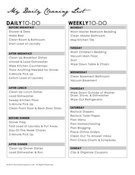
Now Available: Free Customizable Chore Charts and Daily Cleaning Lists
Thanks to the efforts of Joy from FiveJs.com, we now are offering free customizable Chore Charts and Daily Cleaning Lists. You can customize all the fields with chores for your children or cleaning tasks for yourself and then save and print them.
Download the free customizable Chore Chart Pack here and the free customizable Daily Cleaning Lists here.
Super Savings Saturday
I ended up not using any coupons this week, but I got some great deals by shopping the markdowns. Here were my grocery purchases:
Health Food Store Shopping Trip #1: Spent $12.90 — see the complete price breakdown and details of this shopping trip.
Aldi Shopping Trip: Spent $16.79 — see the complete details and price breakdowns of this shopping trip.
Health Food Store Shopping Trip #2: Spent $19.35 — see the complete details and price breakdown of this shopping trip.
Would you like to know what the best deals and coupon match-ups are for your local stores? Be sure to check out the Store Deals section of our site where we post the best deals and coupon match-ups each week for over 100 different stores across the country. You can sign up to receive the top deals in your email inbox each week as soon as they are posted!
Did you snag any great deals or bargains this week or save money in other ways? If so, be sure to post about them on your blog and leave your link below. Please remember that this weekly round-up is to share deals you personally got and/or money you were able to save this week. In order to keep this weekly round-up focused on helping and inspiring others in their efforts to save money, links which have little-to-no content other than promoting affiliate links, etc. will be deleted. Also, to make it easy for everyone to navigate quickly through the links, your link must link directly to your Super Savings Saturday post.
Monthly Financial Update

It’s a new year and if you’ve not done so yet, I’d highly encourage you to sit down and set some financial goals for 2011. It’s amazing the momentum you can receive from having specific, written goals.
Here’s our list, continued over from the middle of last year. We tweaked it a little bit because, after prayer, thought and research, we’ve set our next BHAG (big, hairy, audacious goal). By the end of 2012, we’re hoping to have enough saved to purchased a piece of commercial real estate as investment and residual income.
1. Continue to give generously needs in our community and around the world. This is an ongoing goal that we’re making a priority every month, so we’re keeping it uncrossed off from the list.
2. Pay cash for a replacement washer and dryer for our very used set.
3. Pay cash for a replacement for Old Blue Van.
4. Pay cash for a couch for our basement family room.
5. Pay cash for bunk beds for the girls.
6. Fully fund our IRAs.
7. Bump up our retirement savings to 10% of our income.
8. Fund our children’s educational savings.
9. Double our Emergency Fund Savings (Instead of having around six month’s worth of expenses set aside, we’re planning to set aside a year’s worth of expenses.)
10. Save 40% towards our goal of paying cash for commercial real estate.
We’d love to hear about your recent financial goals and successes! You can post about it on your blog and leave your link in the comments. Or, just share about your progress/goals in the comments. Let’s all keep each other accountable to be better stewards of our resources!
We Paid Cash! :: Japanese Language School
A testimony from Melissa
My husband was born in Japan and only came to the U.S. 12 years ago. His entire family is still in Japan, so it was important to us that our children learn Japanese.
Our first child was born six years ago, and though my husband spoke to him in Japanese, my son only picked up bits and pieces because I don’t know the language, so my son couldn’t hear real conversation.
The Background
We discovered a Japanese Montessori Language school close to our home, but it came with a hefty price tag — $750 for half-day Japanese instruction and $970 for half-day Japanese instruction and half-day English instruction.
At the same time, my husband was in graduate school and making little-to-no money monthly. We were living entirely off my teaching salary, but it was very important to us that my son learn Japanese so he could communicate with his relatives.
How We Did It
Here is how we paid for three years of Japanese language school (we estimated this cost us $27,000 over the three years):
- Have only one car. I drove the car, and my husband took public transportation.
- Limit eating out. We try to spend less than $100 a month on eating out.
- Cook in bulk. This eliminates the need to eat out after a crazy day and also helps to lower the grocery bill.
- Take on additional work opportunities. Throughout the three years, I occasionally took on extra work at the school I taught at to make some more money.
- Subscribe to basic cable. We only had the cable that was necessary to get in regular broadcast channels.
- Have date night at home. We couldn’t afford the cost of a babysitter and going out, so we often had a date night at home and rented a movie and ate take out. When we did go out on a date (rarely), my mom watched the kids for free.
- Buy and keep a minimal wardrobe. Many of our clothes come from thrift shops or consignments stores. If I did buy new for work, it was always at a steep discount.
- Keep electronic luxuries to a minimum. We only have one cell phone that we buy minutes for when we need it. We don’t have iPods, mp3 players or any other modern electronic gadgets. A digital camera is about as advanced as we get technologically.
- Pack lunches. My husband and I both packed our lunches every day so we wouldn’t be tempted to eat out at work.
The $27,000 we invested in my son’s language development had a hefty price tag. We still rent and probably will for several more years. However, it is a sacrifice we are willing to make so our children can communicate with their grandparents, aunt, uncle and cousins in Japan.
In another year we will be paying for my daughter to attend the same school, but in our opinion, it is money well spent.
Melissa is a stay-at-home mom to three children ages 6, 2 and 6 months. She and her husband are now saving for their next child to attend Japanese school. She blogs at Mom’s Plans and Dining Out Challenge.
Have you saved up and paid cash for something — large or small? Submit your story for possible publication here.
OVER-SPENDING EVERY SINGLE MONTH?Grab these FREE Budgeting Sheets!
Click here to download!From the Email Bag: Using Coupons Changed Our Lives
I get so many wonderful, encouraging emails from many of you. It’s always inspiring to hear your stories of living frugally and how it has made a difference in your lives.
I just thought I would share this story from Kim in hopes it might encourage and inspire you as it did me:
2009 was a tough year for my family. While we had planned financially for the birth of my son, we hadn’t planned on complications during pregnancy that resulted in my two-month hospitalization away from our home town, extensive medical bills and NICU stay and a 180-mile daily round trip commute for my husband between home, work and the hospital.
Just as we got baby healthy and home, we had another blow: My husband was laid off with no notice right as I was scheduled to go back to work from maternity leave. He qualified for unemployment, but the difference in income from his paycheck was a big one, and we now had lots of expenses from this latest addition to our family.
That was the day I first did a Google search for “coupons” in attempt to find ideas to help stretch our budget and our lives changed dramatically. I always thought because I have a “good” job, that I didn’t need to use coupons because I wasn’t in dire straights. Little did I know that coupons are not only used by those in many different income brackets, but that there is enormous savings potential if you just become an informed shopper.
The $20-$30 a week I was hoping to save quickly turned in hundreds of dollars a month and more. Our family not only learned to survive on less – but to thrive on it. We were able to afford for my husband to be a stay-at-home dad for a year to our preemie son, giving our little guy a chance to get bigger and stronger with lots of personal attention from dad.
We were also surprisingly able to live a more comfortable lifestyle. Even while watching our spending, we were still able to buy everything we needed, and still had room in our budget for growing our savings, starting college funds for the kids and even for extras like vacations. Using coupons and being smart about our shopping has helped our family be in better financial situation than ever before, and earlier this year, we were even able to pay $5000 cash for a new roof for our house.
My husband is back to work, and my son is now strong and healthy, but we’re still continuing our savings efforts for the better of our family. My husband and I feel it is important to share our good fortune, and our savings efforts have enabled us to be able to generously share with others. We love taking large care packages of our deals to family and friends, and we have also been able to make regular donations to our children’s school, the local food pantry and more.
We’ve had so many people ask us for advice and information, we have even started a blog to share local deals with our own community. It’s great hearing from readers who are now saving money and able to better make ends meet because of information we shared.
-Kim from 2 Kids and a Coupon
Today’s Shopping Trips: Aldi and the health food store
Today, Kaitlynn and I had a little outing to the health food store and Aldi. I wasn’t planning to go to the health food store since I’d already gone on Tuesday, but Kaitlynn loves to go there (they have little children’s carts and samples!) and asked if we could please go, so we stopped by. And I was so glad I did because I found some great deals!
Health Food Store Shopping Trip:
3 loves of Rudi’s Organic Bread — marked down $0.99 each
1 bag of Rudi’s Organic Hot Dog Buns — marked down to $0.99
3 bags of Rudi’s Organic Bagels — marked down to $0.99 each
1/2 gallon of organic milk — marked down to $2.99
2 4-packs of priobiotic drinks — marked down to $0.99 per pack
1 bag of avocados — marked down to $0.99
1 bag of sweet potatoes — marked down to $0.59
2 bags of oranges — marked down to $0.99
2 bags of apples — marked down to $0.99
Spent $19.35
Aldi Shopping Trip:
1/2 gallon of orange juice — $1.79
2 cans of refried beans — $0.69 each
1 dozen eggs — $1.16
1 bag dried cranberries — $1.39
1 bag oranges — $1.49
2 bags baby carrots — $0.99 each
Tortillas — $0.99
2 packages of cheese — $1.79 each
Lemon Juice — $1.89
Spent: $16.79
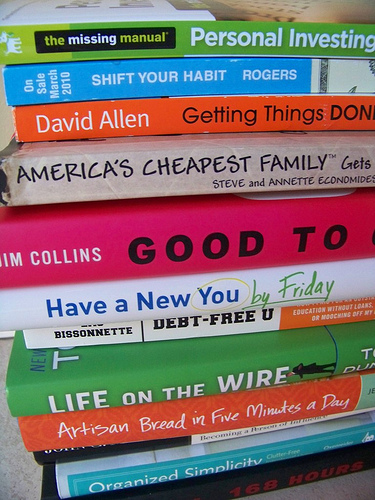
24 Books I Plan to Read in 2011
This year, instead of coming up with an entirely-too-ambitious list of books I want to read (like I did last year!), I decided to only pick 24 books I want to aim to read in 2011. I’ve broken my list down into a month-by-month basis to help keep me on better track.
Business and Financial Books I Plan to Read and Review This Year:
January — 168 Hours: You Have More Time Than You Think
February — Organized Simplicity: The Clutter-Free Approach to Intentional Living
March — Becoming a Person of Influence
April — Artisan Bread in Five Minutes a Day: The Discovery That Revolutionizes Home Baking
May — Life on the Wire: Avoid Burnout and Succeed in Work and Life
July — Have a New You by Friday: How to Accept Yourself, Boost Your Confidence & Change Your Life in 5 Days
August — Good to Great: Why Some Companies Make the Leap… and Others Don’t
September — America’s Cheapest Family Gets You Right on the Money
October — Getting Things Done: The Art of Stress-Free Productivity
November — Shift Your Habit: Easy Ways to Save Money, Simplify Your Life, and Save the Planet
December —
Personal Investing: The Missing Manual
Other Books I Plan to Read This Year:
January — Calm My Anxious Heart: A Woman’s Guide to Finding Contentment
February — Pour Your Heart Into It: How Starbucks Built a Company One Cup at a Time
March — The Possibilities of Prayer
April — The Blessing of Boundaries
May — Three Cups of Tea: One Man’s Mission to Promote Peace . . . One School at a Time
June — Honey for a Child’s Heart
July — One With Christ
August — A Charlotte Mason Companion: Personal Reflections on the Gentle Art of Learning
September — Womanly Dominion: More Than A Gentle and Quiet Spirit
October — The Rose Conspiracy
November — Disciplines of a Godly Woman
December —
Benjamin Rush: Signer of the Declaration of Independence
I plan to review the Business or Financial book of the month on my blog on the third Friday of each month and I’ll also give a little update in that post on the other book(s) I’ve read in the past month.
If you want to read more this month and could use some accountability, Jessica from LifeAsMom is hosting a Booking It In 2011 Challenge.
Ask Jesse: Should we stop contributing to our 401K to pay off debt?

I was wondering what you thought about our decision not to start contributing to a 401k until we are out of debt. My husband and I are both early 30’s and while it scares me sometimes that we have not even started saving for retirement, I feel a stronger need to get out of debt first. We have a long way to go on our debt-free plan (four to five years), so I don’t know if we should try to do both at the same time, because it would slow the debt payoff. What would you do if you were in our shoes? Thanks for your advice! -Alysia
The question of continuing retirement investing while paying off debt or getting onto a better financial footing is a tough one. There are many opinions, but you specifically asked what we would do so that makes it much easier.
I started retirement investing about a year after graduating from law school. At the time, I was working for a government agency and was not eligible to contribute into the State’s retirement system, because I had not been working as a full time government employee long enough.
I had the opportunity to take advantage of a deferred payment plan, but elected to keep more of my paycheck to help us get our emergency fund established. Once we reached our $1000 emergency fund level, I cut up the credit card I was keeping from law school supposedly for “emergencies.” Having the same amount of cash that I had as a credit level made me feel a lot more free to get rid of the thing.
It was not until then that I sat down and began planning for retirement. Because we were in our late 20’s, I opted to only throw a couple hundred dollars at it monthly through my automatic investment program with the mutual fund provider. This allowed us to save more towards our short-term goals. I know Dave Ramsey may not approve, but that is what I did because it fit our budget and our plan.
When we started saving in earnest for our house, I stopped retirement savings and funneled everything to that savings goal. My thinking was that we are young and would much rather have a paid-for house now and catch up on our retirement savings later. However, if we didn’t have the blessing of a good income and low expenses and it was going to take us longer than five years to pay cash for a house, we likely would have tweaked our plan and saved for retirement while we were saving for a house.
So, to answer your question, yes, I would (and did!) stop retirement in the short-run to build momentum to meet short-term savings goals but only if this would put us in a better long-term financial situation.
If it is just saving for a vacation or a new car, forget about it. Nothing in the short-run, apart from paying cash for a house or paying off debt, would deter me from taking advantage of the Eighth Wonder of the World in my retirement account — compound interest!
Jesse Paine is a licensed attorney who owns his own law firm. He’s married to Crystal and is the numbers nerd of the MoneySavingMom.com team! If you have a question you’d like him to answer in a future column, you can submit it here.
The content of this column intended for informational use only and is not to be construed as providing legal, investing, accounting, or other professional advice. Your situation is factually specific and you should accordingly seek qualified professional counsel concerning your specific legal, investing or accounting needs.
5 Time Management Tips for Busy Families
Guest post by Jennifer from I Heart Organizing
1. Invest in a Great Daily Planner
My daily planner is my lifeline. It goes with me everywhere I go.

Planners have been around forever, but they are really the most genius way to keep it all together. Every paper that comes home from school with a date on it, instantly gets written in the planner.
What’s for lunch on Wednesday? It’s in the planner. What should I blog about on Monday? Oh yes, also in the planner. What night is garbage night? Family night? It’s all written down in the planner, and color-coded by category (i.e. blog post, meal plan, school event, etc.) When the planner is not physically attached to me in some way, it’s sitting on our counter to be viewed by anyone in the family.
If budgets are tight, with a little creative thinking, a spiral notebook could be transformed for anyone looking to adopt this idea.
2. Make Family Night a Priority
Family Night gets scheduled in each week at our house, just like an appointment.

Family comes first and with the hustle and bustle of all things entertainment, family functions, school activities and sporting events, important family bonding can quickly become obsolete. Making sure to pen it in each week and learning to say, “No” to other obligations that may come up on the same night, is extremely important to us spending quality time together on a weekly basis.
3. Solve the Schedule Equation
On top of tossing all of our important schedules and appointments into the planner, we quickly found that it was still easy for us to get lost in our nightly routine. A quick video game or blog post writeup could simply turn into hours of lost time.
Trying to juggle homework, making dinner, baths, one-on-one time, story time and blogging was definitely a lot to manage without any type of direction. I knew I had to figure it all out, in order to completely maximize our evenings together (not to mention our super speedy wake-up-and-get-on-the-bus mornings!)
Something I found incredibly easy to do, was to break out the day in half-hour increments and plan out a “typical” day in our life.

Just looking at all the times slots paired up with all the things that I was dreaming of accomplishing in any given day was great for ensuring we get time to do all the things that matter, from time with our little ones to personal time on our hobbies or interests. I popped my visual breakdown right on the side of the fridge, because it’s great to have a time management reference point if I ever feel like we are getting a little lost.
I was beyond surprised that when the day was broken out there was so much time in the day that I then instantly wondered how I had been wasting it away in the past! Of course not every day is laid out perfectly as there is such a thing called life, but having a plan for our days has definitely proven to keep our daily goals in check and ease in our time management prioritization.
4. Create a Meal Plan
A very obvious time saver for us is meal planning. We have a meal plan/shopping list that hangs inside our pantry door, ensuring that when something runs out, we can it right to the list. Using the coupons that we have clipped along with trying at least one new recipe each week, we plan out our weekly meals before we head off to the grocery store.

Only spending time shopping for what we need, saving some money not buying what we don’t need and then doing as much of the preparation ahead of time means all we need to do is peek at the planner each day and make whatever is on the list!
5. Set Up a Dump Zone
We use a memo station to stash kid’s papers that we get home throughout the week, along with all of our mail.

Each Sunday I take a quick 10-15 minutes and recycle or file all the papers in each slot. We also have a dump basket with the same philosophy.

Since piles can form so quickly, and as much as I believe in the “return things right where you found them” idea, it’s not always practical. Keeping one basket or bin dedicated to dumping our “stuff” each week, is easy to stash away when company comes, and is gone through at least once a week to return items to their home. This is also a great task for little ones looking for ways to become more helpful around the abode!
Jennifer is currently a stay at home mom, that not only cares for her own children {three uber beautiful little boys}, but also has the opportunity to spend her days with a couple other little ones as well, as a daycare mom. She is also currently working to start up an in-home organizing business, manage an organizing blog {where she talks about things like managing cleaning schedules and creating easy ways for kids to get organized} and working on expanding an Etsy shop as well.