

We hear a lot of talk about priorities. And it’s with good reason: we need to know what is important in our life so we can make decisions on how to best use our time and resources.
However, what is also equally valuable is to know what’s NOT important. I loved how Kevin DeYoung described these not important things in life as “posteriorities”. Here’s what he said on page 62 of Crazy Busy:
This means, in addition to setting priorities, I must establish posteriorities. This is Drucker’s word for the thing that should be at the end (posterior) of our to-do list. These are the things we decide not to do for the sake of doing the things we ought to do. Making goals is not enough. We must decide what tasks and troubles we will not tackle at all. -page 62 from Crazy Busy by Kevin DeYoung
Are you spending time and energy on things that aren’t really priorities? If so, what can you do to make them posteriorities in your life?
One thing that helps me tremendously is to set yearly goals, monthly goals, and weekly goals. These help me to stay focused on chipping away at things that are important to me or taking slow and gradual babysteps in the direction of where I want to go.
I also find it so helpful to make out a loose schedule for each day with time blocks for each hour of the day as opposed to just making a to-do list. Maybe it’s just the Type A in me, but I have a tendency to create impossibly-long to-do lists. These just set me up for failure since there’s no way I can cram 32 hours’ worth of work in a 24-hour day.
Instead of writing a long to-do list, I’ve found it’s much more productive to make a loose schedule with time blocks at the beginning of each day. Instead of trying to fit my long to-do list into only 24 hours, I start with 24 hours, deduct 8 hours for sleep and 2 hours for margin time, and then schedule the rest of my day within the remaining 14 hours of time blocks.
When I start with only 14 hours — and that’s all I have to work with — I have to be a lot more careful what I plan and commit to.
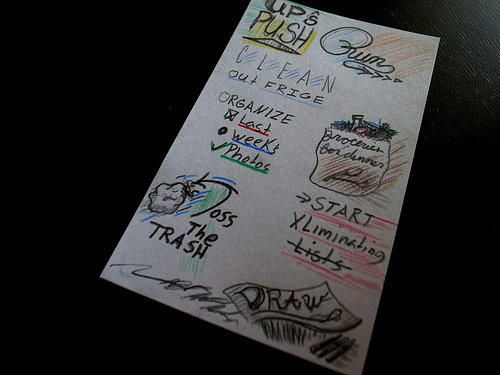
Here are three questions I ask myself when thinking through tasks on my mental to-do list and writing out my time blocks for the day:
1. Does this task have to be done at all?
Many times, I realize that a task I had on my mental list isn’t a priority at all — just something was feeling obligated to do or thought would be nice to do?
2. If the answer is “yes”, then does this have to be done today?
I’m not trying to encourage procrastination here, but a realistic view of what is a priority for today. If something needs to be done but doesn’t have to be done today, I’ll usually add it to my Google calendar for a later date. That way, I’ve assigned it to a day and don’t have to worry about it until it shows up on the calendar again.
3. If the answer to the above question is “yes”, then can someone else do this task?
There are many tasks that must be done, but that I don’t necessarily have to do myself. These can be assigned as a paid chore to one of my children or delegated to one of my team members.
These three questions help me to streamline and pare down my to-do list and stick with the most important things on my time block schedule for the day. And you know what I love best about pre-planning my day within the 14-hour time block parameters? It helps me to start the day not feeling overwhelmed because I know that everything I’ve planned to do that day actually fits into my day — with room to spare!
What are some things you need to put on your posterities list? If you are still trying to fit them into your life, today is a good day to shelf, trash, or delegate them.

 Do you have a fun and frugal DIY idea to share? I’d love to hear about it! Read the submission guidelines and submit it