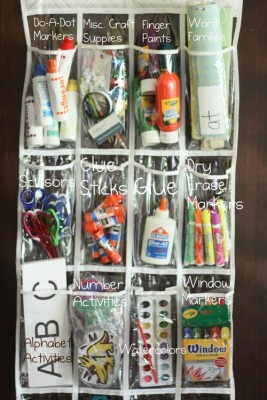
Clay In His Hands shows you how to make a Girl’s Ruffled Skirt out of a t-shirt.
Do you have a fun and frugal DIY idea to share? I’d love to hear about it! Read the submission guidelines and submit it here.

Saving Families Money Since 2007


Clay In His Hands shows you how to make a Girl’s Ruffled Skirt out of a t-shirt.

Here are my answers to the questions you all asked in the comments of last week’s How to Make Money Blogging post:
Anyway you could talk about how you deal with negative comments/criticism? This has gotten me really discouraged lately. -Jenae
I’m so sorry you’re dealing with negative comments and criticism, Jenae! Unfortunately, the sad reality is that if you have a blog that is read by more than a handful of people, you’re probably going to get some negative comments. I’ve met some of the most wonderful people through blogging, while at the same time, I’ve had to learn to develop thick skin for those very frequent comments and emails from people who don’t like my blog.
There’s no way to please everyone; it’s just a fact of life. And when people can hide behind an anonymous identity and say whatever, some people feel comfortable saying very harsh things–things they would likely never say to your face.
One thing that has really helped me is to remember something Dave Ramsey said at his EntreLeadership conference: “You are not accountable to those you don’t have a relationship with.”
I have many real-life friends who I see on a very regular basis who read my blog. If they come to me with a concern about something I post, I’m going to take it very seriously, pray about it, examine my heart, and seek the Lord to see if I am in the wrong.
If, however, some anonymous person posts or emails a comment bashing decisions or choices we’ve made or criticizes something I post about, I try to remember to just let it roll off my back as I know that they are only seeing a snippet of my life through my blog.
And I try to use negative comments and criticism to remind me of the need to extend grace to others. I want to be a cheerleader and an encourager to others–even if I don’t always agree with them. I want to “find the good and praise it”.
Early on in your blogging career when you were trying to take every opportunity to get your blog out there, how were you able to chase every lead or network often and still have a family life?
I have chosen to put the blogging aside for most of the day and only work on it at night after my children go to bed. But I have found that it leaves me little time to network because this is also when I write my posts, not to mention spend any quiet time with my husband. I also fear that I’m losing some valuable networking opportunities. So, do you have any advice on how to balance it all when one is early on in their blogging?
If you choose to have your priorities in order, you will lose valuable networking opportunities. However, the value of putting your husband and family first far outweighs a lost networking opportunity.
I’ve had to learn this lesson the hard way. As I’ve mentioned here before, I’ve had seasons where I completely overextended myself and my marriage and family suffered as a result. It breaks my heart that I made wrong choices; I can’t get those days and hours back. But I can learn from the past in order to forge ahead into the future in a more God-glorifying manner.
My advice is to continue to strongly guard your priorities and let the blog take a backseat. However, talk with your husband about what may be a good balance for you. At times, we’ve set aside an evening each week for me to go to a coffeeshop and write. During other seasons, I’ve gotten up earlier than the rest of the household in order to write. Naptimes have also been great blocks of time for blogging, as well.
Once you determine what works for your family right now, set specific goals for your blogging time. Make writing a priority, but see if you can also carve out 15 minutes a day for networking. Perhaps five minutes for commenting on other blogs, five minutes for networking via email, and five minutes for networking via Twitter. Or, you could just choose one of these per day to focus on.
Set the timer and work as fast as you can during the designated time. Five or 15 minutes might not seem like much, but if you stay focused, you can accomplish a lot in that timeframe. A little bit of focused work each day can really add up over six months’ time.
What are the tax implications for blogging? My husband has worked as a consultant in another industry and all of those ‘small business’ fees add up. Since you are self-employed, at what dollar amount do you have to start reporting your income to the IRS and filing paperwork? -Amy
You need to report every dollar earned to the IRS. However, some states don’t require you to pay taxes until you reach a certain threshold of income earned. In addition, there are many deductions you can take when you are operating your own business–even if you just operate it as a sole proprietorship.
I’d heartily suggest that you keep blogging income completely separate from personal income. Set up a separate bank account and funnel all money earned through that account. This makes it so much easier to track income and expenses–and prevents co-mingling of funds.
For more information on tax implications of running your own business, I’d highly recommend sitting down with a local accountant.
There are already so many blogs out there about motherhood and saving money. It seems like this is already so saturated that it would be difficult to stand out or earn money. Do you have any suggestions about how to pick a topic and maybe about areas that are not so saturated? -Jennifer
Honestly, I don’t believe there is any blogging market that is truly saturated–except the market of bloggers who are trying to just mimic other bloggers instead of following their own passions and finding their own voice.
When picking a topic, think less about what areas of the blogosphere are “saturated” and more about where your giftings and passions lie. Focus on writing about what you love, what you’re interested in, and what unique experiences you’ve had in life that give you a perspective others might not have. When you do something because you love it, you’ll be enthusiastic about it and that enthusiasm will breed energy and excitement among others.

Today’s question is from Mary:
Like many families in this current economy, we struggle just to make ends meet. Paycheck to paycheck is how we have been living.
Due to a slight loss in income, money is tighter than it ever has been. As a result, I find it hard to stockpile. If you don’t have extra money to spend, do you even try to stockpile, or do you just try to save on the items you normally buy?
Do you have a question you’d like to ask Money Saving Mom® readers? Read the submission guidelines and submit it here.

Guest post by Jenae from I Can Teach My Child
Once upon a time, I started a coupon blog. After blogging for nearly eight months, 14 people read my blog.
Yes, 14. Most of these readers were family and close friends who probably read out of pity.
I learned quite a few foolproof ways to not have a successful blog. Here are just a few (this is all tongue-in-cheek, by the way!):
::Blog about something you are not 100% passionate about. I love getting a good deal as much as anybody, but my passion for couponing seems to come and go–mostly due to burnout. Write down the five things in life you are most passionate about and make sure not to blog about one of those. 😉
::Blog infrequently. Go weeks or even months without posting–it makes life more exciting for your readers! Readers love not knowing when they can expect a post.
::Don’t write any original content. Readers only want to read on your blog what can be found at thousands of other blogs. Make it a point to not write any original articles.
::Be a recluse in the blogging world. Don’t comment on other blogs or participate in link-ups. After all, if people really want to find you, they will.
Yes, these “tips” certainly helped to make for a blog that nobody wanted to read–including me, come to think of it!
Thankfully, I was able to learn from these mistakes on my second attempt in the blogging world (www.ICanTeachMyChild.com) when I swallowed my pride and tried again last July. I zeroed in on one of my life’s passions–teaching children.
It’s amazing how much fun I have when I blog about something I am passionate about! I vowed to post frequently. Most of my posts are ideas original to me or inspired by others. I love the new friends I’ve made in the blogging world and the community that has been created.
Most of all, I’ve learned from my own mistakes. I’ve learned that it’s okay to fail and that failures are often life’s best teachers.
Jenae is a Master-degree holding former first grade teacher turned stay-at-home Momma. She loves finding creative ways to save money, spending time with her family, and sharing fun activities on her website I Can Teach My Child.
After some financial difficulties, my husband and I are back on track in our lives. I am at home with the children and he is working very hard. I do clean a condo on the weekend for some extra money.
Since we are on a tight budget, saving for a home of our own is going to take some time, maybe even several years. I know you were once in this situation. How did you stay patient? I find myself dreaming of cottages and looking at the real estate listings. I don’t want to feel like I am “just passing time” until we reach our goal.
How did you find the patience when “waiting” for a home? You always seemed so at ease and calm during that time. -Dawn
First off, I will tell you that I’m not naturally a patient person. I’m a get ‘er done and get ‘er done now type of gal.
However, God has taught me a lot about patience in the last nine years of my life. Over and over, things haven’t worked out in the timing or way I would have chosen. There have been unexpected job losses, there have been multiple times when we didn’t know what we were going to do for employment or where we would be living the next month, there have been business failures, and there have been many other setbacks.
It’s been hard, but oh-so-good for me to have to learn to wait and to learn to embrace less-than-ideal situations because that was pretty much the only choice I had. And looking back, I can truly see that God’s timing has always been much better than my own timing.
I know beyond a shadow of a doubt that I wouldn’t be writing this blog, I wouldn’t be writing a book, and my husband wouldn’t be running a successful law practice if it weren’t for the hard lessons we learned through times of waiting. So be encouraged; waiting can be a wonderful thing!
Here’s my advice for you:
Where do you hope to be in three to five years from now? Sit down with your husband and map out some specific written goals of where you want to be at the end of three to five years.
Then, break these down into small monthly and weekly goals. For instance, if you hope to have $15,000 saved in three years to use as a down payment on a home, you’ll need to save $5,000 per year. This translates to $417 you need to save per month, or around $105 you need to save each week. If, after reviewing your budget, you realize this is just not feasible, either revamp your goal, extend the timeframe, or find some areas in your budget to cut.
This specific weekly figure gives you parameters to work with. You now know exactly how much you need to save each week to hit your goal on target. You may not be able to hit the $105 figure each week, but proactively aiming for it will give you much greater momentum in actually achieving your goal.
You can’t afford a house right now, so don’t even look. Window shopping almost always evokes discontentment.
Avoid real estate listings, don’t stop at any open houses, and don’t shop for future furniture online. Just block all of it out of your mind right now–except to let it propel you towards your weekly and monthly goals.
Instead of focusing on what you don’t have, seek to embrace and make the most of what you do have right now. Maybe you are crammed into a crackerbox apartment. Rather than waking up and going through your day grumbling about the lack of space, let it motivate you to pare down, get creative with organization, and be thankful that a smaller home means less to clean and more time to spend doing things you enjoy.
According to statistics on WiseGeek.com: “Over three billion people — more than half the world population as of 2010 — live on less than $2.50 US Dollars (USD) a day. More than 80% of the population lives on less than $10 USD per day.”
Most of us know nothing about true poverty. Times might be tough, finances might be tight, and you may be worried about how you are going to stretch your paycheck to cover all the expenses you have, but most of us cannot imagine what it would be like to live without a roof over our heads, clothes on our backs, shoes to wear, food to eat, running water, a working toilet, and so many other things things we consider necessities that many in the world would deem to be luxuries.
If you didn’t have to rummage in the garbage to scrounge up something to eat for lunch today, if you didn’t sleep on a cardboard box under a bridge last night, and if you own more clothes than you are currently wearing, you have much to be thankful for.
I’d love to hear from the rest of you: what helps you to be patient while waiting for something you really want?


Okay, so I have to admit that I wasn’t too enthused about this Busy Bag from our Busy Bag Swap. It seemed so simple that I figured no one would find it too exciting. Well, was I ever wrong! This is, by far, Silas’ favorite Busy Bag Activity to date.
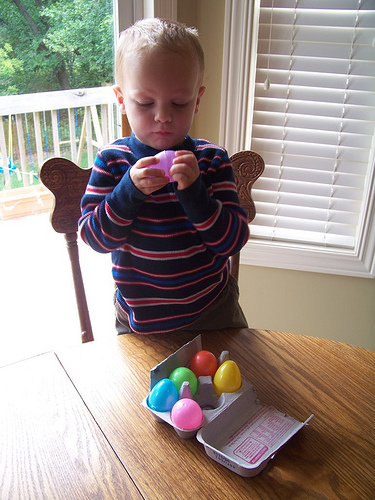
He has taken the plastic colored eggs in and out of the egg carton more times than I can care to count. And he’s enjoyed every minute of it!

We were also thrilled to discover that Silas could match all of the colors of the eggs to the colors colored on the bottom of the egg carton. The girls and I had so much fun cheering him on as he did it right and then we couldn’t wait until Jesse got home so we could show him, too!
See more details on creating an Egg Carton Busy Bag here. Find more Busy Bag Ideas here.

Breakfasts
Chocolate Chip Pancakes, strawberries
Whole-Wheat Waffles, peaches
Scrambled Eggs, Bagels
Blueberry Ginger Smoothies, Toast
Whole-Wheat Pancakes, fruit
Granola, fruit
Egg McMuffins, fruitLunches
Peanut Butter Banana Wraps
Tossed Salad with Hard-Boiled Eggs, Toasted Bagels
Peanut butter & Homemade Jam Sandwiches, Apple Slices, Peas
Macaroni & Cheese, Fresh Apple Carrot Juice
Beans and Rice with cheese, frozen veggies
Leftovers x 2Snacks
Peanut Butter Chocolate Chip Muffins
Chocolate Chip Chewy Granola Bars
Chocolate Peanut Butter Banana SmoothiesDinners
Ravioli, Tossed Salad, Fruit Salad
Southwest Roll-ups, Fruit Salad, Chips & Salsa
Taco Chicken Bowls, Fruit Salad
Steak, Brown Rice, Frozen Vegetables, Fruit Salad
Crockpot Barbecue Chicken, Au Gratin Potatoes, Frozen Vegetables, Fruit Salad
Dinner at Party
Dinner at Extended Family’s HouseFreezer Cooking in an Hour
What’s on your menu this week? Share details and/or your link to your menu plan in the comments.
 A reader emailed me the following testimony that I thought would be an encouragement to some of you:
We had the pleasure recently of giving a sizable gift anonymously to an acquaintance who is in great need, and it reminded me once again of how fun it is to give this way. We recruited an out-of-town aunt of a friend to hand-deliver an envelope for us. She didn’t know the exact contents of the envelope, but just that it was meant to bless the recipient.
Afterward, our emissary even thanked us for the chance to be part of the process. In addition, yesterday the acquaintance who received the gift chatted with me for a minute and told me about the gift, calling it “the biggest blessing of my life”. It was so fun to be able to rejoice with her, all while she had no clue the gift originated with us!
After several years of doing this type of thing, my husband and I agree that it’s our favorite way to give personal charitable gifts. The fact that we are anonymous means that our relationship with the receiver is not affected at all; there is no sense of obligation or superiority whatsoever!
We also reduce the chance of being approached for an additional gift in the event that the receiver would do such a thing. We truly can say that it has been a pleasure, and that we feel like we are God’s instruments rather than the ones really giving the gift!

I was so blessed and inspired by Dr. Henry Cloud at the Women of Faith conference last week. One of the topics he spoke on was happiness.
He shared three keys that much research has shown led to deep happiness. Want to know what they were? Being a giver, having close friends around you, and setting goals.
I’ve always known that goal-setting gave me much fulfillment and purpose for living life, but I thought it might just be because I’m rather Type A and all. So it was encouraging to me to know that scientific research backs up what I’ve experienced in real-life meaning goal-setting is not just something that helps Type A folks like me. Whether you’re Type A or Type Z, it will positively impact your life!
As promised, here’s an update on my 10 goals for last week:
Last Week’s Goals
1. Start our homeschool year.{We started last Monday and it’s been going really well!}
2. Finish reading Revenge of the Red Knight aloud to the children.{Done.}
3. Put together Busy Bags for Busy Bag Swap.{Done.}
4. Run 12 miles (total). {Only ran 11.5 miles, but I was happy with that since it’s harder for me to fit in exercise while traveling.}
5.
Finish reading The Charlotte Mason Companion and Eat That Frog.{Still working on Good to Great.}6. Vacuum underneath beds. {This one totally slipped through the cracks.}
7. Make Homemade Fruit Leather and Homemade Scrubbing Bubbles. {I didn’t do either of these–time just got away from me!}
8. Wash, dry, fold, & put away one load of laundry every day (except for Thursday-Saturday when I’m in Indianapolis). {I did really well at this on Monday and Tuesday, but didn’t do any laundry the rest of the week–I’m hoping to do better this coming week because it really makes a difference!}
9.
Shoot videos and send to publicist.{Done.}10.
Write two birthday cards, one anniversary card, and one thank you note. Help girls write birthday cards to those who have birthdays this week.{Done.}
Note: Since this is a public blog, I won’t be sharing all of my goals (such as my marriage goals, etc.), so if you’re wondering why it seems a little unbalanced in certain areas, that’s why.
Mothering Goals
1. Finish reading Homer Price aloud to the children.
2. Take children on a Nature Walk.
Personal Goals
3. Run 12.5 miles (total).
4. Finish reading Good to Great, Quitter, and Raising a Soul Surfer.
Home Management Goals
5. Vacuum underneath beds.
6. Make Homemade Scrubbing Bubbles and homemade soap.
7. Wash, dry, fold, & put away one load of laundry every day.
Business Goals
8. Re-shoot videos and send to publicist. {She liked the ones I sent last week but wants me to make a few changes and resend them.}
9. Go through my formatted and edited manuscript from the publisher to check for errors in format or content.
Ministry Goals
10. Meet with a friend who asked for counsel.
How did you do on last week’s goals? What are your goals for this week? If you feel comfortable doing so, I’d love to have you share your progress on last week’s goals and your goals for this coming week in the comments. Let’s cheer each other on to live purposeful and productive lives!

A testimony from Megan
When we had our first child, Cadence, we knew that it was very important to us that her room always be hers. Growing up my husband and I were both raised in homes where money was tight and bedrooms were furnished with acquired odds and ends.
There was nothing wrong with living like this as we both completely understood then (and now) that having clean, functional items was good enough and was all that was manageable. As a child, though, it was sometimes hard to stomp on the green envy monster that would show up when visiting a friends home who had a fantasy bedroom.
Call it living vicariously if you want, but we really wanted to give our daughter that dream room on two conditions: we did not want to break the bank and we wanted to do it without acquiring any debt. So when Cadence turned 16 months old, we moved her into the spare bedroom in our home and slowly started turning her nursery into an amazing big girl room with hopes that she would be moved into it by age two.
We salvaged. My daughter’s twin size bed was given to us by my parents. The dressers were mine when I was a child. My husband made the bedside table and the headboard was purchased off Craigslist for $15.
We did the work ourselves. My husband did all of the renovations and furniture refinishing himself. He installed a new closet system and doors. He sanded, painted, and varnished all the furniture. He painted the room, made all the trim, and replaced the floors. We saved thousands by not hiring a contractor.
We asked for help. For our daughter’s first birthday, we let the family know what bedroom set we had chosen for Cady and made a Target registry with all the pieces we needed. Instead of receiving a lot of toys and clothes that she really didn’t need, Cady received almost every bedroom item as a gift for her birthday.
We got creative. We checked websites and chose craft items that we thought would make a huge difference in the room and set out to make them ourselves. I sewed stuffed owls and made a mobile from branches. We painted $1 birdhouses from the craft store to match the room scheme and used them as 3D decoration throughout the room and my husband whittled drawer pulls for the dressers he refinished.
We only bought supplies on sale or with coupons. Paint was purchased with coupons and rebates and flooring was purchased from an outlet store for $0.69 a square foot.

After all our labor, the end result was a gorgeous Magical Forest bedroom fit for a princess that was finished in plenty of time and well within budget (less than $2000). A renovation like the one we did would have cost nearly 10k if we had used outside labor. Cady moved into her new room and started sleeping in a big girl bed at 21 months old and we couldn’t be happier with the outcome!
Megan Carlisle is a homemaker and mommy to one little girl (and another baby due in January 2012.) She is married to David and they live happily ever after in rural Pennsylvania! In her spare time, she enjoys couponing, the show Criminal Minds, and that amazing feeling you get when all your laundry and dishes all done (for the moment!).
Have you saved up and paid cash for something — large or small? Submit your story for possible publication here.
Amber emailed in with the following tip:
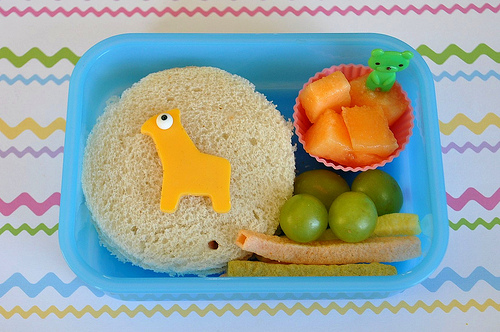
We save $200+ a year by packing my son’s lunch for school. The daily lunch at our school costs $2.15, so for the 180-day school year, the cost of buying lunch is $387.00!
I have found that I am easily able to pack my son’s lunch including a healthy entree, salty side, fruit and “treat” for no more than $1 a day. I’m blessed that he prefers his filled water bottle to a more expensive drink, however, even adding a drink would still have significant savings over the purchase price.
This year we will save about $200 (I’m figuring there will probably be 10 lunches that will end up being purchased over the course of the year). Yahoo! Given the potential savings, I decided I would purchase a thermal entree container to send his favorite leftovers. It will be a $3.99 well spent.
I started my planned freezer cooking session yesterday earlier than usual because I had some packing and other loose ends to tie up before my trip to Indy today. Here’s the play-by-play:
12:30 p.m. — Lunch is done and the children are busily occupied with arranging the new dollhouse furniture a friend is letting them borrow, so I start making the Taco Chicken Bowls. The only problem is, I can’t find the frozen corn that I know I have. I scour both freezers in earnest and finally find it. The search was worth it, though, because I also turned up a bag of whole-wheat flour I didn’t realize I had. Yay, I don’t have to grind any wheat to make the muffins today.
{And yes, I need to get some better freezer organization in place! Anyone have an incredible system they want to share with me?}
12:45 p.m. — I finish up the Taco Chicken mixture in the crockpot and turn it on low and head over to my trusty laptop for the Peanut Butter Chocolate Chip Muffins recipe. In the process, though, I get distracted with something on my computer (I can’t even remember what it was. Probably drooling over something or other on Pinterest.)

1:00 p.m. — Um, wait, wasn’t I supposed to be making muffins, not just looking at pictures of recipes I want to make?? The clock jolts me back to reality and I start in on the muffin recipe. I decide to make a few adjustments using all whole-wheat flour, peanut butter instead of peanut flour, eggs instead of flax, coconut oil instead of olive oil, and raw sugar. Okay, so the final recipe may have ended up being nothing like the original recipe, but it still looked (and tasted) good!

1:15 p.m. — As soon as the bag of chocolate chips comes out, all three children magically appear and want to “help”. I let them sprinkle the muffins with chocolate chips and then they lick the bowl while I put the muffins into the oven. By now, my kitchen is a mess, my long to-do list is still looming, and I decide to just make the homemade pizza for dinner instead of my ambitious idea of making Homemade Fruit Leather. Oh well, I’ll try it another week!

1:30 p.m. — I quickly roll out the pizza dough and sprinkle the toppings on. I’m impressed with how easy this dough rolls out after thawing on the countertop that morning.
{By the way, the pizza crust ended up baking up really well. My husband loved it; I’m still partial to our standard recipe, but I’ll admit that the freezability of this recipe is quite appealing!}
1:45 p.m. — Done and time to clean up the kitchen!
Another fun Busy Bag we received in our Busy Bag Swap box was a “Pom Pom Stuff It In” activity, as Brenda called it. I’m quite sure what to call it, but let’s just say that Silas loved this activity.
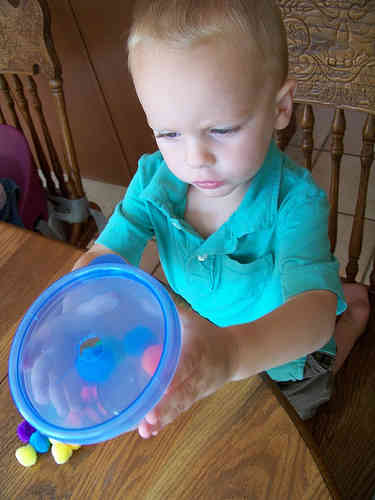
It’s basically a small plastic tub of some sort (you could use a yogurt or sour cream container) with a hole cut in it to push pom poms through (you can find pom poms really inexpensively at the dollar store or at Hobby Lobby).

Silas had so much fun stuffing these in. When he was done, he dumped them all out and started over again. And he’s done it again and again like that!
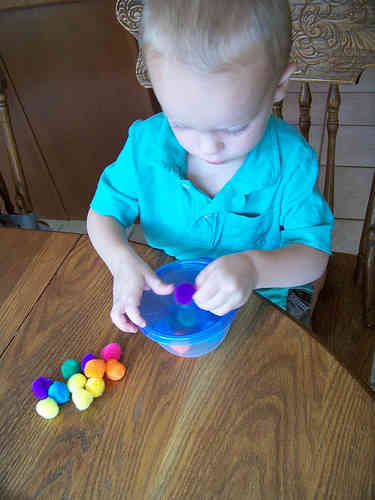
This simple activity kept him happily occupied for quite a long while during our homeschooling time this past week and he hasn’t seemed to lose any interest or excitement about it yet!
See more details on creating a Pom Pom Stuff It In (or whatever you want to call it!) here. Find more Busy Bag Ideas here.

Two weeks ago, we talked about teaching an online class and writing an ebook as two ways to earn money indirectly through blogging. Here are three additional ideas:
If you love public speaking (or want to grow to love it!), you can make a fairly good side income through accepting public speaking engagements. If you don’t have people beating a path to your door offering to fly you to their event and pay you to speak, never fear, you just need to work on getting your name out there and building up a reputation as a highly sought-after speaker.
Depending upon your blog’s topic, you could offer to speak at local events for free in order to build your portfolio. Or, you could offer a class through your local community center for a small fee per sign-up. If the class is well received, you could offer it on a regular basis or teach the same class in nearby towns, as well.
If you hope to be asked to do more speaking opportunities, you could set up a page on your blog that outlines details on what speaking engagements you accept, past speaking experience, testimonials, future speaking engagements, and how people can contact you about possibly speaking at their event.
As an added bonus, speaking engagements can put your name and blog name in front of dozens or even hundreds of people who haven’t heard of you or your blog before, helping to grow your blog and widen your audience.
Blogging has opened up a few doors of opportunity for me to have extra paid writing gigs on occasion. It’s been a great experience, as well as extra cashflow. While it’s been a long time since I’ve sought out such opportunities, I know that there are many available–especially if you are a gifted writer.
If you want to do more freelance writing and are having trouble finding opportunities, contact small local parenting magazines across the nation. Many of these accept articles and pay up to $25 per article. Best of all, since these are local and state publications, they don’t ask for exclusive rights. So, hypothetically, you could spend a few hours on one article and pitch it to 100 different small publications. If even 10 of them run it, you could make $250 off it. That’s certainly nothing to sneeze at!
Again, in most publications that you write for, you can include a bio with a link to your site. You might not get a lot of traffic from it, but it will more than likely send at least a few new visitors to your blog.
Many companies are taking notice of bloggers and realizing that we are much more adept at online marketing and social media than they. They want to know how they, too, can grow their business through blogging and social media. As a result, there are numerous companies who are more than willing to pay bloggers to give them tips and pointers–or even to take over their social media presence for them.
Consulting jobs pay well–often upwards of $50 or more per hour–but they are more difficult to get. Usually they are the result of networking and pre-established relationships.
My biggest tip is that you don’t sell yourself short or work for free. Sometimes companies expect bloggers to offer consulting services for free, just because, well, you’re a blogger. If a company comes to you and asks for advice on something that’s going to require more than 15 minutes of your time to help with, write back and let them know you are more than glad to consider helping them and your fees are $XX per hour (charge at least $20 to $25 per hour, if not more, to make it worth your time).
Your time is valuable and, unless it’s a ministry or nonprofit or some other company that you have strong ties to, don’t give them free handouts. This only hurts all bloggers when companies have the idea that they can get hours of consulting services from bloggers without paying. They wouldn’t expect to hire a consulting firm without paying them, so they also shouldn’t expect the same or similar services from bloggers without paying.
As I’ve dipped my toe into the world of book publishing this year, I’ve learned many lessons. One of which is that getting your book published is not as hard as many may think. If you’ve built up a strong blog audience, have a social media presence, are passionate about your subject, and are a decent writer, you can likely get a book deal.
However, don’t do what I did and just accept whatever book deal a publisher offers you. I learned that the hard way. While my publisher has been excellent to work with, I wish I would have gotten my agent first before signing the book deal. There were a lot of little things I knew nothing about and having an agent to help me chart these never-before-navigated waters would have been invaluable, as well as saving me some headaches and hassles later. But oh well, live and learn right?
My advice? Come up with some winning book ideas and then get a great agent. You’ll not only have an advocate and a go-between for pitching your book idea to publishers, but you’ll have someone to hold your hand and cheer you on through the process.
This is the final format post in this series on How to Make Money Blogging. If there are lingering questions you still have or topics you’d like for me to delve into deeper or explain further, leave a comment or email me. If there are enough questions asked, I’ll do a follow-up post next Wednesday.