


Guest post from Lisa of Cooking Up A Sale
I can feed my family of 6 for $10 a week! It’s really not very much work. I hardly spend any time at all hunting down deals! And you can do it too!
Okay, not really. I wrote the above tongue-in-cheek, because I’ve never heard anyone claim that.
But reading stories like this can be frustrating as you work to lower the number at the cash register. To avoid frustration when trying to cut grocery and household expenditures, keep it real… by keeping these things in mind:
There is no magic, one-size-fits-all formula.
It’s easy to read those “How I Feed my Family of X on $X Per Month” and get frustrated, discouraged, and even annoyed. “I’ll never get my grocery bill that low, because my daughter has a food allergy/my husband won’t eat meatless dinners/we eat all organic/my store doesn’t double coupons/I don’t have a garden.”
Maybe you’re right. Maybe your monthly grocery bill won’t ever be as low as the author’s. But remember that you will never find another family exactly like yours with all the same ages, appetites, allergies, taste preferences, access to discount stores, and so forth. This means that your approach to saving money on grocery and household items won’t be identical to anyone else’s.
Instead of getting frustrated, take what you can from the article or blog post and move on. And then read another article or blog post and take what you can from that one. Pick and choose your savings strategies to create your customized cost-cutting plan.
The savings will not fall in your lap.
If you want to see that dollar amount drop, it’s going to take some work.
There are so many free resources available, from coupon classes and food trucks to deal-matching websites and frugal-living blogs. But you have to make the effort to find them!
Likewise, any advice you read will not do you any good if you don’t put it into practice. You can read one article after another about how to menu-plan, clip coupons, find good deals on produce, can and freeze in season, and get your toiletries for free, but if you don’t follow through on what you’ve learned, you won’t see the savings.
Time is money.
I’ll never forget that important lesson taught by my high school economics teacher! Not only do you have to put the effort into following through on money-saving advice and strategies, but all that follow-through takes time.
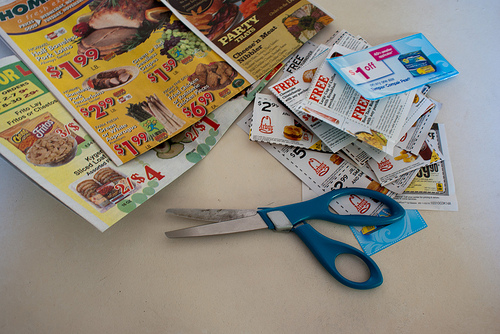
Matching up sales with coupons, making all your kids’ snacks from scratch, planting a garden… those are all great ways to save money, but each requires a time commitment.
You can’t expect to shave your expenditures very much if you’re not willing to commit at least a small amount of time to money-saving tasks. Stated positively, this means that, in general, the more time you spend working on ways to save money, the more money you’ll save.
It’s all about making choices… and compromises.
For example: because of my time and space constraints (and my brown thumb!) I paid to join a CSA instead of planting a garden. Secondly, although I know that eating rice and beans for supper one or more nights each week would save us money on food, I decided to try to stretch our meat a little further rather than serving meatless meals.
- Maybe eating all organic produce is important to you.
- Maybe you have multiple small children, so you decide you aren’t going to play the drugstore game.
- Maybe you really need to tighten your belt, so you decide you’re going to have peanut butter and jelly sandwiches for lunch (or supper!) all month.
- Maybe baking isn’t your strong suit, so you decide to purchase snacks instead of make them from scratch.
All of these are choices that will affect the grocery line item of your budget. Some choices make it go up, and some choices make it go down.
Decide what’s important to you and your family, and then plan accordingly. And remember, different things are important to different people and this means that we all choose to spend (and save!) our money differently. Instead of getting frustrated with bloggers or commenters who make different choices than you, strive to appreciate the fact that there are so many different ways to save money.
There’s nothing new under the sun.
Well, maybe there is once in awhile. If you’re a newbie to frugal living, there’s probably a lot of new-to-you information available. But if you’re an experienced coupon-clipper/sale-shopper/
Sure, it’s fun to discover a new way to save money on food and household items, but as a rule, the same basics (coupons, discounted produce, menu-planning, stockpiling) are preached by everyone for good reason: they work.
Don’t get frustrated when bloggers or others don’t constantly spoon-feed you new information. Instead, challenge yourself to think outside the box all on your own — and then have fun passing your own money-saving idea on to others!
It’s important to be realistic about our savings efforts so that we don’t get frustrated and decide to quit trying. Let’s all remember to encourage each other in our savings endeavors!
Lisa is a Michigan wife and mother who loves to spend time in the kitchen. She enjoys the challenges of menu-planning around grocery sales and creating delicious food using on-sale ingredients. Lisa blogs about two of her favorite topics – food and saving money on groceries – at www.cookingupasale.blogspot.
com


















 Do you have a fun and frugal DIY idea to share? I’d love to hear about it! Read the submission guidelines and submit it
  A testimony from Sylvia