
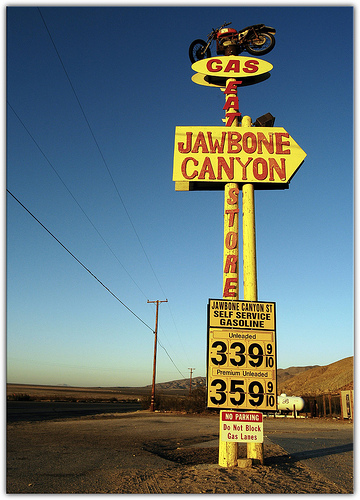
In Part 1 of the 15 Ways to Save Money on Gasoline article, I suggested buying lower octane fuel as a way to save money. Well, Kristen would disagree with me and it looks like she’s done her research to back that up. Here’s what she emailed in:
We’ve heard that by upgrading your fuel octane lever, you can get better gas mileage. Since one of our vehicles is a truck, we are always looking for ways to cut back on our gas costs. We actually spent a month calculating the miles we got at octane level 87 and 89. We found that while 89 was on average $0.03 more per gallon, we actually get better gas mileage with it.
My husband gets 11.6 miles per gallon on our truck with 87 and 12.6 miles per gallon with 89. We have a 26-gallon tank, so basically we get one more mile per gallon when using 89. That means we get 26 extra miles per fill-up! Looking at our mpg, we save about two gallons’ worth of gas each time we fill up (the amount will vary depending on gas prices; it’s anywhere from $6-$8 per trip).
For example:
26 gallons at $3.50 per gallon of 87 = 301.6 miles for $91.00 ($0.302 cents per mile)
26 gallons at $3.60 per gallon of 89 = 327.6 miles $93.60 ($0.286 cents per mile)This might not sound like much, but when you purchase 100+ gallons of fuel per month, it adds up quickly. Depending upon gas prices and mileage, we will save at least $100 to $120 per year by using higher octane fuel.
I’m curious: have any of the rest of you calculated whether or not you save money by buying higher octane fuel?
I would suggest that this issue be approached with extreme caution… please read and confir with your vehicle’s manufacturer. Many engines are designed for the lower octain. Mine is. When you use a higher octain gas in an engine, like mine (Prism), it can actually damage your engine. No one wants repair costs.
My car requires 91, but it does seem like 89 can go a long way more in the average car than 87. $0.10/gallon isn’t that much, as Kristen’s calculations prove. For similar reasons, I would suggest higher quality gas such as Chevron (Texaco) and Shell over Arco (BP). Your will last longer, and the money you save on maintenance and repairs outweighs the small increase in gas costs. Elizabeth and others put it well.
You get what you pay for, and if you go cheap for the short-term you have to pay in the long-term, and this applies to many areas of life.
I appreciate the tip. I am inspired to do the math on my own vehicles with our local prices to see what works best for us.
I concur with Kristen. I have an older 3/4 ton truck, and the difference in mileage is enough to be worth higher octane fuel for me. I don’t have exact numbers to send in, but all of my tests have indicated that the difference was worth it.
If you use fuel that is too cheap, depending of course, on the needs of your type vehicle’s engine, you WILL PAY FOR IT BIG TIME, in car repairs. We have friends here with a nearly identical make car to ours and they will drive MILES to find gas a penny cheaper (is this what is called pennywise and pound foolish)…and they have had to have so much work done on their car engine too! We have not. My hubby used the mid level octane, and sometimes adds a bit of the higher level as well as some marvel mystery oil in both gas and oil, every so often…helps keep things running cleaner. Our 2000 model intrepid still gets nearly as good gas mileage as when it was new. He does frequent oil changes, too….everything he can do…changes filters, etc. These are not expensive items, but they will make a difference in the long run for your engine. Another thing we try to do, is to let the engine warm up a little before leaving the driveway…engines will last longer if you take good care of them. Both hubby and I come from families who have done car repairs for their living…hope this helps.
A friend who lives in Charlotte, NC where like most big cities today, all the fuel has some ethanol in it, said his friend who works on car engines said that since this change in the fuel, their work to replace filters, fix gummed up engines, etc. has gone up 1000%! Something to think about. When we were on a long trip recently and that was the only fuel available, hubby made sure to go to Walmart and get some of the additives that are to help your engine NOT get gummed up from that stuff…
Around here 89 octane gas has ethanol in it. That lowers your mileage. 87 doesn’t have ethanol so we get better milage with it. It is also 10 cents more expensive. But the gain in mileage we get we come out ahead. I actually have found no gain in mileage with the 91 octane over the 87 in my car. Yet my husband does get better mileage with 91 over 87 in his vehicle. You just need to make sure it doesn’t have ethanol it. Not only will it lower your milage but it is actually bad for your car.
I can’t say myself whether the octane affects mileage – the amount of ethanol surly does. However, if anyone wants to “experiment” to see if they get better mileage with a higher octane, be sure to also not WHERE those miles were. My husband keeps up with my gas mileage – I give him my receipts and he keeps a spreadsheet. He’ll occasionally tell me that I got better mileage in a particular week; every time it’s been in a week when I had some highway mileage. Most of my driving is in town with a lot of red light, picking up kids, etc. But every now and then, I have a shopping trip up the interstate 20 miles, and that one trip increases my MPG significantly. Idling at red lights is definitely wasteful!
I work for Volkswagen, and after reading this I went out to our shop to talk to one of our Master Certified techs to get facts based on experience. He says that the biggest advantage of using higher octane fuel is that it does burn cleaner, therefore creating less wear and tear on your engine. He also said that it does save you money on your gas mileage, and while you really do have to factor is cost per gallon versus savings per gallon, overall it’s better for your engine. I can tell you from seeing so many astronomically high repair bills coming across my desk (I’m an extended warranty administrator) that anything you can do to save wear and tear on your engine is worth it. I own a 2005 Jetta GLI 6-speed turbo, and it was recommended that I use higher octane, and I did..at first. I switched to lower because I was trying to save money and the knocking began and my car was not accelerating like it did on higher octane – meaning I had to step harder on the gas, using more. With my car already being in the 160k range, I’m going to do what I need to do to take care of it. We have so many customers who do regular maintenance, use higher octane, and they drive their cars into the 400k-500k range. That’s amazing. But if you do choose lower octane, be sure to use fuel injector cleaner. Also, when purchasing a car, especially a newer model, make sure you are clear from the beginning on what kind of oil your car uses. Volkswagens MUST have full synthetic, and a lot of newer Nissans I know use full synthetic. We have a lot of frustration around here when people buy a VW from an individual or a small used car lot, and don’t know to use full synthetic. They have their cars towed here, and 90% of the time need an entire new engine because they either changed the oil themselves using standard, or took it to a 10-minute oil change location who didn’t know the difference. Even if they bring it into us for their first oil change after buying it from one of these places and not knowing about the oil, when they find out the price of a synthetic oil change versus a standard oil change, they go through the roof. In short – be an informed buyer!
I drive a 96 Volvo, and find that I get ten, yes 10, miles a gallon better mileage (31 as opposed to 21) buying non-ethanol gas as what is regularly sold, even over premium. I often have to pay as much as $0.10 a gallon more, but it is well worth it.
My husband has done detailed calculations (he has a spreadsheet even) and says that he gets better mileage with the higher octane. I still cringe when I with him and he fills it up though, despite logic!
LOL my husband did the same thing when he figured this out. He’s very into his spreadsheets!
It really depends on your car, I know that all german vehicles it is better for but for most japanses normal octane is fine. So I’d ask the car dealer, also if it is better for your car in the long run it will cost you less. so gas stations have better deals on higher octanes look for those.
We have a Ford Expedition.
Wow, hot topic! I actually read thru all the comments and had to add my $.02. We mainly drive diesel vehicles, so I have no opinion whatsoever on octane levels.
— If you drive alot, I would strongly urge you to consider a diesel vehicle. The VW Jetta (2006) that we had got 40+ mpg. It was sporty, responsive and roomy too!
— In ANY vehicle, as part of regular maintenance, check your air and fuel filters! Your engine has to work harder to pull air thru a dirty air filter and will burn more fuel to do so. Your fuel filter is there to protect your fuel pump. Filters are easier to change and cost much less than a new pump!
— The best way to save on fuel is to really watch the way you drive. Don’t floor it every time you take off, stay around 60 mph (as long as the posted speed limit isn’t 55 😉 ) and turn off your overdrive when you’re driving under 45 mph (I don’t know if this will actually save fuel, but it’s better for your transmission because at lower speeds like that, your vehicle will actually shift back and forth between the two highest gears).
We had an 02 jetta TDI. No savings what so ever once you consider how EXPENSIVE they are to fix when something breaks down. And the low sulfur diesel they have gone to is junk. We are so glad to be rid of that car and now I have an 01 Honda 5-speed manual (gas). I get just as good of mileage in it and it is so much cheaper to maintain! just my .02…
I just wanted to share that according to the US Dept of Energy, you SHOULD user a higher octane if your engine is knocking and pinging (ours does this on lower octane):
http://www.ftc.gov/bcp/edu/pubs/consumer/autos/aut12.shtm
Thanks for the post. Everyone has their own opinion. We have a 10 year old Honda odyssey with almost 200,000 miles and we have noticed that it runs much better on higher octane. Manual calls for 87 but it sputters and a very noticeable difference. We have another vehicle v8 luxury which calls for higher octane and we have noticed that it runs better on a particular brand that we try to stick with. It doesn’t hurt to look at your individual situation and do what is best for you and your family
Does anyone know how I can find out about additives and ethanol in the gas sold at different stations? With gas heading quickly to over $4/gallon, I’d love to be able to find the best bang for my buck!
I was wondering the same thing!
Melissa, I did a web search. One article stated that every station is different and that all gas contains ethanol (thank you, federal subsidies). Apparently the amount of ethanol varies by location so they suggested to call your local stations, ask for the manager and ask them.
I can only imagine how helpful they will be! LOL I’ll keep looking around to see what I can find!
Ok, someone else said that there should be a sticker on the pump stating how much ethanol is in it. I’m sorry (maybe) to say that my husband does most of the fuel pumping around here so I’ll have to go and look next time! But that is certainly easier than calling the station and asking!
There should be a sticker on the pump that tells you whether the gas you’re buying contains ethanol – most of them say “up to 10%.” Where we live, the stations that carry ethanol-free gas ADVERTISE it prominently.
This is a great tip that I would like to experiment as well. I am always looking for ways to save on gas, and with Bi-Lo fuel perks, one time I got gas for $1.76/gallon.
May be I could try this with fuel perks to maximize my savings : )
Thanks.
My husband always purchased higher octane fuel for his truck before we got married, and I’ve just recently convinced him that it is not necessary. Maybe we’ll have to do an experiment like this though… Gas is our second highest expense (after rent) so we’ll take savings in any way we can find it!
Also, we have to make sure to only buy gas from certain chains of stores. Some stations in MN put additives in their gas that do NOT agree with my husband’s temperamental truck. My car takes everything just fine, but we’ve gotta be careful with the truck. For example, we avoid BP if it can be at all avoided. The truck makes strange noises and sucks gas when we use it.
I’ve never even considered getting better mpg that way – I will have to experiment! If it is true for most cars, I guess that is the one good thing to the fact of my husband having to put premium in his vehicle 🙂
If she saves one cent per gallon, she’d have to use 10,000 gallons per year to save $100. Assuming 25 miles to the gallon, that’s two hundred and fifty THOUSAND miles in one year! More than the road life of many cars! If you’re wearing out a car a year, you’re driving wrong 🙂
A much better fuel-saving idea: don’t speed. Engine efficiency drops off significantly once you get above 55 MPH. If you go 70 instead of 65 on the highway, you lose ~8% gas mileage. Going slower also saves wear and tear on your tires and produces less road pollution. (Think about it – where do your tires go? Wear on your tires is just bits of your tires getting ground off and turning into air pollution of getting into the water supply near the highway.)
Something else to consider – a 30-mile trip at 60 MPH takes half an hour. Going at 55 MPH instead takes a whopping 32.7 minutes – two minutes longer. I take longer than that just to find my keys most of the time!
See the updated post. She clarified what she meant and it was $0.01 per mile, not gallon. I hope that helps!
Be careful about switching around “just because”! My engine is made to run on the cheaper gas. It is an interesting concept though – my husband’s landscape business spent $15,000 on JUST gas last year!
I was the one that submitted this tip.
I just asked my husband to clarify how exactly he did this (I was providing second hand information that he gave me). He said he gets 11.6 miles per gallon on our truck with 87 and 12.6 miles per gallon with 89. We have a 26 gallon tank, so basically we get 1 more mile per gallon when using 89. That means we get 26 extra miles per fill-up. Looking at our mpg, that means we save about 2 gallons worth of gas each time we go (the amount will vary depending on gas prices – anywhere from $6-$8 per trip). That means that as long as 89 is priced no more than $.26 above 87, it’s still a better deal.
For example:
26 gallons at $3.50 per gallon of 87 = 301.6 miles for $91.00 ($.302 cents per mile)
26 gallons at $3.60 per gallon of 89 = 327.6 miles $93.60 ($.286 cents per mile)
Sorry about my typo, I didn’t mean $.1 per gallon, I had meant $.1 per mile.
This accounts to a savings of around $120 per year – depending on gas prices and mileage.
I’ll fix it in the post. Thanks for the clarification!
From the Federal Trade Commission:
At the Pump: Use the Octane Level You Need
* Your owner’s manual recommends the most effective octane level for your car. For most cars, the recommended gasoline is regular octane. In most cases, using a higher octane gas than the manufacturer recommends offers no benefit. Unless your engine is knocking, buying higher octane gasoline is a waste of money.
I just had to comment that your picture is a bit outdated. Its about $1 more than that now. LOL! I am dying of laughter here. That’s over by where we live. Just outside Red Rock Canyon.
Another problem with her scenario is… The savings would have to be determined based on driving the same route everyday for both tanks of gas. No deviatiopn. If you took the interstate everywhere for the two weeks with that tank of gas of course you are going to have better gas mileage. If you took backroads to work or the grocery store with stop and go traffic then your gas mileage would be lower. I do not feel that this is enough savings to properly determine which gas is better to use.
suppose to be deviation ooops
Check out this link about the topic over at Cartalk: http://www.cartalk.com/content/features/premium/questions.html
Basically they are saying that premium gas provides no additional benefit for cars that were designed to run on regular gas. Of course there are exceptions, like cars with a specific type of engine (high compression). They suggest basically using regular unleaded unless the engine is under a lot of strain, like over mountain passes or when hauling a heavy load (towing).
You can check out Premium Gas Myths here (One of which says, that Premium Gas gives you better gas mileage, MYTH BUSTED, lol):
http://www.cartalk.com/content/features/premium/myths.html
I haven’t done the detailed calculations that she has done, but I can say that I do get better mileage cause I calculate (most of the time) the miles I get per gallon when I fill up. One of our local stations actually sells the 89 at the same price as the 87 which helps a lot.
Road Ranger does that around here, they sometimes go by the name Citgo as well. I try to fill up there because it is 89 octane, but only if I happen to be near a station.
I calculate the mileage when I fill up too. Always get 87 gas, and my mileage can vary wildly — from 16mpg to 24mpg. And sometimes I can not even figure out why the differences — as far as I can tell I’ve done the same sort of driving, etc.
My husband is a car and aircraft mechanic. He puts different grade fuels in different vehicles. His old 1980’s truck, he puts the higher grade in, as well as Marble Mystery Oil or Seafoam additives in the gas and Slick 50 in the oil. He’s seen several mile per gallon increase in his gas mileage doing this. It may not save money with the additives, except for the fact that it makes for a healthier and longer lasting engine. Also, putting the cheaper grade gasoline in means that you’re putting dirt and *water* into your fuel tank which messes with ignition and fuel pumps. When his S-10 pickup started lurching, we know we’ve just bought gas with water in it……very bad.
Cheaper grade does not = water in gas. Poor tank maintenance = water in gas.
what do you mean by “poor tank maintenance”? please explain.
I am by no means a car expert, but I’ve been told by more than a few mechanics and an automobile engineer that a car’s engine is designed for optimal performance using a particular octane gas. So, if your engine is built to use 87 octane and use 91 octane, you won’t see any benefits and could hurt the performance of your car (or vice versa). I’ve never put this to a test, though! I’d follow the recommendation in the owner’s manual.
I am not going to try to figure out anyone’s math, however I do appreciate her caring enough to try to help us see things in a different light. We are all in this together and when we find something that helps us, we should share it and then once it is shared it is up to the individual (us) to do what is best.
I can’t speak to the differences between octanes, but higher fuel mileage from fuel that doesn’t contain ethanol is well documented. It’s less expensive, and it is a partial-alternative fuel source, but it doesn’t get as good of mileage.
I have no idea whether this is true or not, but I do have something to add! Buying “cheap” gas will burn you in the long run. My mom had been buying gas from one of the cheaper gas stations in town and she went on a trip– her fuel pump went out in her two year old car! The mechanic told her it was because her pump had collected so much debris from using lower-grade, off brand gas. That fuel pump completely nullified any savings she had accrued from using the cheaper gas. Moral of the story: just because it’s cheaper does not mean it’s better, and just because a gas station has a name-brand logo does not mean that is the particular fuel they carry. Always check the ins and outs so you won’t have a huge catastrophic event like my mom had! 🙂
Another hint…never let your gas get below 1/4 of a tank. the gas keeps the fuel pump cooler and when you consistantly run in down to nearly empty, it shortens the life of your fuel pump.
My husband claims that only filling the tank halfway is a fuel saver too. The less weight the engine has to pull, the less gas it uses.
Many gas stations in here (Fargo, ND) it is about 3 cents per gallon cheaper for mid grade and others charge 10 cents per gallon more for it. I know that it is cheaper for mid grade at Sams Club.
I believe if you were to combine just one trip a week, you would most likely save that $1.00 per month, with out doing anything else!
Where using higher octane gas comes in handy is if you live in harsh weather during the winter months. The higher octane fuel will help your car perform better in those months and keep your car running at its optimum even when the weather is not.
Once you hit spring and summer the lower octane is fine since your car is not put through the riggers as much.
Not knowing the miuntae of what the dollars and cents are saved, I do know that this tip will help give your car longevity and perform to a higher standard when you need it the most.
I agree. I haven’t calculated the mileage, but our vehicles run better on mid-grade during the winter months, too, especially since we don’t have a garage. And it’s the same price as regular unleaded where I buy gas.
interesting concept! i know nothing about cars and gasoline, but a month doesn’t seem like very long to test something when you have all the variables (different errands, weather, etc). plus i’m a little confused about her math… 100 gallons a month at 1 cent equals around $12 a year, not $100!! anyway, i think i’m just going to stick with what my car manual says but thanks for the suggestion!
Haven’t tested the octane idea yet, but my husband and I drive a Toyota Tundra and a Yukon XL, respectively, and have noticed a difference when we buy gas that doesn’t contain ethanol. Both of us get 3% – 7% higher mileage from a tank of ethanol-free gas. (With a lot of stop-and-go, around town driving, it’s toward the lower end, and if we’re putting on a good percentage of highway miles, it tends to be higher.) In our area, ethanol-free gas tends to cost $.07 – $.12 more, but it pays for itself when gas is $3+ per gallon.
Yes, you can get more miles out of higher octane gas, but there are a couple of factors you need to take into consideration:
1. Overall Cost: We have a chain of stations here (Casey’s) that sells 87 and 89 for the exact same price. Why? Because there is a higher ethanol content in the 89. This reduces your mileage, so you’re right back to square one. At the rest of our stores it’s a 10¢-15¢ difference.
2. Your actual vehicle. Don’t read your manual, look online at forums regarding your make and model. Many older cars do not do well with some of the additives that are now in premium gas. We recently purchased a 2001 Grand Am as my commuter car because my truck was costing a fortune. I constantly had problems with it. Turns out that my particular engine does not like one of the new additives. Went back to 87 and haven’t had a problem.
I’m also confused as to how this can save you $100 per year at 1¢ per gallon. The post says she buys 100+ gallons per month. That’s just $1 per month or $12 per year. You would have to buy nearly 900 gallons per month to save $100.
Around here, some of the gas stations offer “mid-grade at regular price” on certain days. If I need gas on one of those days, I go ahead and buy mid-grade, and I have seen a difference of about 30 or so miles per tank. In my car, that comes out to a little more than a free gallon.
I might have to give this a try. Higher octane is always 10 cents more, but we shop at Kroger and they give you ten cents off per gallon for every $100 you spend a month…so this way I can try it without paying the higher price!
I would say it’s worth a shot to test your vehicles mpg using both. Fill your tank, keep the receipt and reset your odometer then do the math! For my husband and I it worked out he got a little better gas mileage with 91/93 octane in his sedan, while in my quad cab pickup there was no difference at all.
Personally, I’ve found that it’s more about which station I buy my gas from rather than the octane level. I don’t think there is enough savings either way for anyone to be sure which gas is truly better. According to my mechanic, you should go by the car manufacturer. He also says higher octane will only save you money on gas and repairs if you have a high performing engine, otherwise you’re just wasting money. He puts the higher octane in his show car, his regular car, whatever is cheapest.
In North East Ohio, 89 is always about .10 more than 87. My father has been an energy and money saving guy since way before it was popular to be. I was raised being told that 89 or higher is an efficient way to save money over the life of your car “if you engine is made for it”. Some larger engines (ie: a large truck) are made to service better with higher octane fuel. Smaller engines are different. I imagine part of this debate depends on your type of car and model.
Here the 89 is always 10 cents more, and lately it’s 15 cents more.
I’ve never checked the mileage, but we have definitely noticed that our vehicles run better on higher octane fuel. When we’ve used the cheaper stuff, the engine is more sluggish and turns over more before starting.
Same here, Courtney! We’re driving an 11 year old Ford Windstar and it just knocks and pings when we put in the lower octane, but hums along nicely with the higher octane. Now I’m hoping we’re getting better gas mileage, too!
My husband drives about 1250 miles per week in his own car. He insists on using the higher octane gas, because he has done numerous gas mileage tests and consistently gets better mileage with the premium gas. Also, he says that spark plugs, fuel injectors, and other engine parts last longer when using the higher octane gas. With regular maintenance ( oil changes, etc) and using highter octane gas, he has driven his last two cars between 450, 000 and 500, 000 miles before buying a new one , both of them are still running; just not dependable enough for him to use for work every day. I don’t know how much money we’re actually saving on gas, but I know we’ve saved a lot of money by getting that many miles out of a vehicle before having to replace it.
Wow! That’s impressive.
What kind of vehicles does your husband drive that he gets that many miles out of????
He drives Nissans and Toyotas. The last was a 1998 Nissan Sentra, he drove it for 9 years and put 480,000 miles on it. Our nephew has the car now and it has 525,000 miles. He’s driving a 2006 Nissan Altima now and it has around 250,000 miles so far…we still consider it fairly new!
higher octane fuels have no special abilities to burn cleaner—it’s all about the pressure under which they spark.
450-500K?!? OMG – awesome!! I have a 2001 Toyota (bought new back in 2001) and am only at 103K. I was hoping to get to that level.
She would have to use over 833 gallons a month in order to save $100 a year at $0.01 per gallon. Not sure what math she was using…..
I was thinking the same thing. At 100+ miles per month, she would be saving a little over $12/yr. as opposed to $100. Perhaps some of the calculations were left out?
I just emailed her about it. I’m wondering if she meant $0.10 per gallon?
I think maybe she meant 1000+ miles. I don’t know about folks that live close to a big town, but I couldn’t imagine using less than 12000 miles per year on the vehicles if you work. That is what is used per year for leased vehicles and that is considered low usage per year. Same with insurance companies. I know my hubby uses way over 1000 per month for milage, but he works about a half hour each way from home.
I just clarified this in my comment below with the calculations.
$3.39 a gallon in that picture?? LOL – I haven’t seen that in 6 months here in Chicago!
Haha same in NY! 🙂
she didn’t say the difference was .01 she said she saved that. I gather she meant she got .04 more per gallon making the difference of .01
That’s what I understood it to mean, also. Over all, she is saving a penny a gallon.
My husband retired from the auto industry. The best bet is to use what the owners manual calls for (it’s also inside your gas cap). No need to go higher than what they call for and going lower can do engine damage.
My father in law is also in the car industry and has been for 55+ years. They suggest using the lowest grade unless your car manual calls for anything different.
Just one of those topics that everyone will think they are right no matter what.At times I buy higher octane when i know i am in a pinch at a cheaper gas station.I guess it all depends on your car,how and where you drive.
My car’s manual says to only use unleaded?
We are talking about unleaded gas. At most gas stations, there are different buttons on the pump that say 87 (regular unleaded), 89 (mid-grade), and 91 (premium). They are all unleaded, just different versions of it.
All three levels of gas in the gas pump are unleaded. “Only use unleaded” just excludes diesel.
When I was a kid, you could buy “leaded” and “unleaded” gasoline, but this was phased out in the 70s due to the potential of lead poisoning.
I will politely disagree with the author of that tip and would suggest that you not use in in your upcoming book.
Higher octane fuel doesn’t “do” anything differently than lower octane fuel. It doesn’t burn “better” or cleaner or more efficiently. Use what your car maker recommends for your vehicle.
Spending .03 to save .01 is not a savings. Cars are sophisticated these days and unless your car has computer controlled ignition timing, using the octane rating is just throwing money into your tank that could be better served elsewhere.
You are misreading what I was saying. Please see my calculations below to understand how it adds up to over $100 per year in savings.
Hi Dorothy — I was wondering if you have any sources or statistics to back up your comment. How do you know that the higher octane gas doesn’t “do” anything?
I know about octane rating b/c I’ve taken high school chemistry, lol. I also live in the Motor City =) The octane rating just relates to how much pressure the fuel needs to spark. Lower number=less pressure=most cars. Really, only those vehicles with a high performance engine (and that’s not what most people have) require the higher octane for optimum performance. But don’t take my word for it—here’s a link to the FTC:
http://www.ftc.gov/bcp/edu/pubs/consumer/autos/aut12.shtm
I totally agree with Dorothy and while maybe the author of this original tip has found this to be true, it would surprise me. (As far as why I believe this, I am a mechanical engineer and worked in the automotive industry for 14 years before becoming a SAHM.) The octane rating on gas is determined by the compression ratio of the engine. Higher performance engines have a higher compression ratio, and require a higher octane rating. Race cars that require gasoline usually take an octane rating around 110. You should never purchase a lower octane that what is recommended for your car because it can cause engine damage. If you buy a higher octane than recommended it will not harm it.
That being said, perhaps the original author of the tip found a gas station with less ethanol or no ethanol in the higher octane fuel. Ethanol definitely decreases your fuel mileage. We have several gas stations in our area that offer ethanol free fuel, and on our large SUV we have found it increases the mileage about 1.5 mpg or about 15%. For our newer small car which already gets 35 mpg, we didn’t notice as much difference.
Thanks. I did find that the US Dept of Energy does recommend using a higher octane if your engine is knocking and pinging (ours does). The link is below in the comments. Not that I tend to believe everything the government tells me, but it is another source saying that sometimes, in certain instances, higher octane gas may be better for the vehicle.
I’m from Michigan as well, but I’m not sure that qualifies me as an expert on cars! 😉
that’s what the smiley face was for…trying to add a little levity to this fairly heated discussion.
I just hate seeing people throw their money out the window (or in the tank) believing junk science that high octane fuel will burn better or cleaner or save your spark plugs or other such nonsense.
Dorothy: If it’s posted here, it’s not going in my book because only original, non-published-before tips are going in the book. Also, I’m not convinced that this would be the case for everyone, which is why I put it out for discussion.
However, if you read how the author of this tip calculated this (see the edited post), you’ll see that it does seem they are actually saving money. But, like I said, I don’t believe this would be the case for everyone. It’s definitely something to consider, though.
Yes, we get much better mileage when we use 89 also. In our area, 89 can often times be about 10 cents more than 87 and those times we stick with 87 because it’s not that cost effective. But I’d say a good 50% of the time 89 costs the same as 87 (I don’t know what makes it change so) and that is when we use 89 and I always notice that my tank stays fuller longer.
We also had a truck that could use traditional gas or ethanol 85 and the E85 had to be at least $.50 cheaper per gallon to break even. It was rare to get it that much cheaper when we owned the truck and of course, as of yesterday it was $.76 cheaper!
After doing the math with my dad, I totally agree that you need to have at least $0.50 difference between E85 and 87. My husband has been following this rule, unless he he plans on towing a trailer, and I have been happy that E85 has been $0.60 – $0.70 cheaper than 87!
It’s not something you can set a blanket amount for – it’s going to vary car by car. It totally will depend on how many more miles per gallon that $.50 gets you.
When I drove a Tahoe, I did the math at the suggestion of a friend and using higher octane fuel consistently got me a few more miles per gallon and it did actually come out to less per mile. The friend drove a Suburban and found the same thing.
Never calculated this but we’re in the same boat as Kari…$.10 more per gallon around us.
I haven’t tried this, but when we lived in Kansas City, we would try to buy gas in Kansas because the gas did not contain ethanol and we would get better gas mileage off of the gas without ethanol than the gas in Missouri that did contain ethanol. It was usually priced about 5 -6 cents higher than the gas in Missouri, but it paid off in the end because it saved us money and we weren’t filling up as often.
I should also say that this was using only the 87 octane fuel – we drive a mid-size car, so we get fairly good gas mileage anyway.
We can only get ethanol gas in our state. It has really hurt our gas mileage. Each time they increase the ethanol in the gas our mileage gets worse. I use to get 35 miles a gallon and now I only get 20 to 21. At first they couldn’t figure why my mileage was down but that was the only that that changed.
And our government wants to add more!
that is disgusting that they are using food to make the gas which doesn’t even do much. what state is this in?????
Check with your dealer or owners manual, not all cars are geared to take a higher or lower octane.
Exactly! Some cars specifically state that using anything other than 87 could damage the engine.
This is what I was going to say. My car says in the owners manual what octane to use. If you have to replace the motor in your car, because you used the wrong gas, you really wouldn’t be saving any money anyway.
According to my math, she is actually spending .02 more per gallon. If the higher octane is .03 more per gallon, and she save .01 she is still paying more.
I think she is making the point that after factoring in mileage and original cost, they are actually saving .01 over buying the lower octance gas. In essence, when factoring in mileage, the higher octane fuel actually comes out at .04 less per gallon because they are getting more miles/gallon.
Oh, that makes sense then. I wasn’t understanding where the savings was. Thanks for clarifying
In my area 89 octane fuel is 13 to 15 cents more a gallon so it would not save us any money.
Higher octane gas in my area (NY) is at least 10 cents more per gallon as well – no savings here.
It’s going to vary vehicle to vehicle, but we found that as long as 89 is priced no more than about $.26 cents above 87 – it’s still a better deal. See my response and calculations below.
My husband is in the car repair business and he always puts higher grade fuel in our vehicles. It saves wear and tear on your engine in addition to potential mileage savings….so is better for the vehicle’s lifetime. He also has seen water in gas tanks from “cheap” fuel purchased at places whose business is something other than gas/fuel.
We notice a significant difference in the way our 11 year old mini-van runs when we use the lower grade so we always us the higher grade. It costs us $8 more per month, but our van is paid off and it has about 150K miles on it so it’s worth the $8 to keep it alive longer!
I’ve never tried this, but in our area, 89 is usually about $.10 more per gallon than 87.
Same here. Though in Iowa it is actually CHEAPER, because they put more ethanol in it, and the ethanol is cheaper out there, I guess. We always try to remember to get the mid-grade when we go out to visit my parents.
Ethanol actually lowers gas mileage significantly, ask anyone that has driven an E85 compatible car. It is less noticeable at 10 or 15% blends but it does add up.
why are they converting food into fuel when we could use other sources of energy to make this more sustainable. Americans forget that we are the largest exporter of grains in this world and there are people going hungry every single day all over the world. If we start converting the food into fuel in significant amounts, we will actually have mass famine in a not so distant future.
I recommend you watch the movie “Food, Inc.”. You will be shocked and amazed at all the things corn is used for, as well as how they are able to sell it for less than the cost of production because of government subsidies. A side-effect of that is that other countries can’t compete on the world market, and their farmers are driven out of business. The movie explains it much better than I could.
Because 89 is $.10 more per gallon for us as well, I wonder if the savings (if any) would be significant. I may have to do some calculating of my own!