Earning & Managing Money

Every week in 2013, I’ll be sharing a different way you can save $100 this year. If you do all of these things, you’ll be able to save over $5,000 this year alone! Many of these things will likely be things you’re already doing, but hopefully all of you will pick up at least a few new ideas or some inspiration from this series.

If you’re short on time and energy, but you want to cut your grocery bill, take advantage of price-matching at Walmart.

It’s simple and easy to do–and can save you a lot of time and money. According to Walmart’s price-matching policy, you don’t even need to bring in the competitor’s ad. However, I usually do, just in case there’s any question as to the advertised deal.

Here are three things I especially love about price-matching:

1. You Don’t Have to Go to Multiple Stores

Instead of running around to three different stores to get the best deals at each of those stores, just circle the best deals in the sale ads at each of those stores and take the ads to Walmart and they’ll match the price.

This saves you gas, wear and tear on your vehicle, and time. Plus, it just simplifies things.

2. You Can Get Great Produce at Aldi Prices

I love the produce prices at Aldi, but I sometimes find that the produce is really picked over or just not looking too fresh. Price-matching the Aldi prices at Walmart will allow you to get the low prices, while also getting fresher produce.

3. You Can Get the Good Deals From Stores On the Other Side of Town

Save yourself gas money and time! Don’t drive all the way to the other side of town for a great deal. Just price-match it at Walmart!

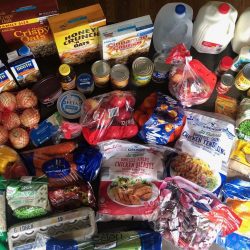
See an example of a Walmart price-matching trip here.

How Much Can You Save?

The amount you save will depend a great deal on how much you usually spend and how often you price-match. However, I can almost guarantee you’ll save at least $5-$10 per price-matching shopping trip — not to mention the time and money on gas it will save you. If that’s the case, if you price-match once or twice a month, you’ll easily save $100+ in a year’s time.

A Word of Caution!

If you’re tempted to buy things you don’t need when you run into Walmart for groceries you might find that price-matching doesn’t save you money since you fill your cart with other things you weren’t planning to buy. If that is a weakness of yours, you might be better off just sticking with shopping at your local grocery stores. :)

For more information on how to price-match at Walmart, check out my video blog.

Have you price-matched at Walmart before?

photo credit

Here’s a hot tip from Jenna:

The first time I did one of the new Jingit offers, I bought paper towels at CVS. After I submitted my receipt scan to Jingit, I got a message that said it would be reviewed and I would be notified when it was approved. Well, the next day, I got the message that it was approved.

I logged back into my Jingit app to check and see if I had, in fact, been paid. There was a new video to watch about the new Jingit offers.

I watched it and was paid $5! YES, $5!

I told my parents and my husband, and they all did an offer and they got the $5 video offer, too! Not sure how long this will last, so you might want to hurry! -Jenna

New cashback offers on Jingit

by Crystal on May 18, 2013

There are some new Jingit offers to check out:

$0.25 cash back when you purchase ANY bread at a participating retailer (Target and CVS came up when I clicked it)

$0.25 cash back when you purchase ANY Hot Dogs at a participating retailer (idea: combine with new $0.75 off Ball Park Lean hot dogs coupon to get a great deal!)

$0.25 cash back when you purchase ANY Ketchup at a participating retailer

$0.25 cash back when you purchase any Lysol Disinfectant Wipes at Target

$0.25 cash back when you purchase Any Paper Towels at a participating retailer

$0.25 cash back when you purchase Any Potato Chips at a participating retailer

$0.25 cash back when you purchase Any box of Trash Bags at participating retailers

$0.25 cash back when you purchase Any Fabric Softener at participating retailers

$0.75 cash back when you purchase Wisk Deep Clean at Target, CVS, or Publix

$1.00 cash back when you purchase a RC TEN 12-Pack, Sunkist TEN 12-pack, Canada Dry 12-Pack, A&W TEN 12-Pack, or 7-Up TEN pack (these are a specific stores as well-so be sure to check first).

$1.00 cash back when you purchase 4- 2 Liters of TEN calorie Beverage (Canada Dry, A&W, 7-UP, Sunkist, or RC)

If you’re new to Jingit, check out this post to see how it works.

Thanks, Our Coupon Adventures!

We Paid Cash: A Minivan

by Crystal on May 18, 2013

We paid cash!

Testimony from Rachel of Intentionally Simple

A few years ago, my husband and I started a car savings account. Our cars were both approaching 10 years old and we wanted to have some money set aside for repairs as well as have enough money saved to pay cash for our next vehicle.

We saved for a few years, and during that time, paid for routine maintenance, repairs and new tires for one of the vehicles out of our car savings fund.

A few months after the birth of our second son, we started talking about purchasing a mini van. We had around $5,000 in savings for a new vehicle and we had the luxury of time to look for a good deal since we didn’t truly need a van at this point.

We decided to put most of our tax return into car savings. The plan was to use the money in car savings (around $8,000) plus the sale of the truck (we were hoping to get around $3,500 for the truck) to pay cash for a new vehicle. We set our budget at $12,000 or less and started researching vans.

We had been researching a few months when my father-in-law told us that a neighbor had a van for sale. The van was a 2004 Nissan Quest with 88,000 miles. It was in wonderful condition and had features like heated leather seats, power sliding doors and lift gate, and a DVD player. The best part about this van, it was well under our budget!

We paid cash for the van without even selling my husband’s truck!

A few weeks later, we sold the truck for $4,500 ($1,000 more than we were hoping, apparently trucks hold their value!) We then put all of the money from the sale of the truck back into the car savings fund so we’re nearly half way to paying cash for our next vehicle.

And, those power sliding doors really are amazing!

Rachel is a wife and mama of two boys. You’ll find her at Intentionally Simple where she blogs about choosing a life of simplicity. Her family lives minimally in a small home and lives debt free.

Have you saved up and paid cash for something — large or small? Submit your story for possible publication here.


Every week in 2013, I’m sharing a different way you can save $100 this year. If you do all of these things, you’ll be able to save over $5,000 this year alone! Many of these things will likely be things you’re already doing, but hopefully all of you will pick up at least a few new ideas or some inspiration from this series.

You can save at least 20% off the price of many staple products by buying them in bulk. If you’re going to be using the bulk amount of something over the course of a year and it can be stored for a long period of time, you might as well purchase it in quantity at a discount, right?

Where To Find Bulk Deals

There are many places to check for bulk deals, here are a few of the best places to look:

1. Warehouse stores

This is sort of the default, but it’s worth mentioning. I save around $27 per year by buying yeast from Sam’s Club instead of at the grocery store. However, I don’t find it is worth it to pay for the membership. Instead, I just go in on the get in free days that they have a few times per year.

Be aware that not all warehouse packages are a good deal. In fact, many times, you’ll pay more per ounce for buying the large package than you’d pay if you bought multiple smaller packages when they are on a great sale at the grocery store.

2. Local farms

You can often purchase large quantities of produce seconds for great prices from local farms (check LocalHarvest.org to see if there are farms near you that sell to the public). And if you like high-quality meat, you’re almost always going to save at least $1 per pound by buying it in bulk.

If you don’t have freezer space for large amounts of meat or products, consider splitting a bulk order with a few friends. That way, you all get the discount, but none of you have to buy a new freezer to store it in!

3. Azure Standard or Other Health Food Co-ops

If you grind your own wheat or eat a lot of oats, rice, beans, or other staple ingredients, check into the prices of nearby health food co-ops or Azure Standard.

3. Health food stores and grocery stores

If don’t find great sources for buying in bulk from health food co-ops and Azure Standard doesn’t deliver to your area, check and see if your health food stores or grocery stores would give you a discount for buying in bulk. It never hurts to ask!

You might also just buy in bulk by practicing the Buy Ahead principle — buying multiples of items at your grocery store when they are at their rock-bottom prices!

What To Buy in Bulk

What you should buy in bulk will vary from family to family. I recommend looking at what you already purchase a lot of that has a long shelf life or would keep in the freezer for six months and see if you can find sources for purchasing it in quantities at a discount.

These will usually be things like grains, beans, canned goods, and meat. But it could also include other items like toilet paper, diapers, or cleaning supplies.

When Not to Buy In Bulk

You can save a lot of money by buying in bulk, but there are a few pitfalls you want to be aware of:

1. Don’t buy things you won’t use up in time

There’s no point in buying a big bulk package of something if you’re just going to end up throwing it out because it goes bad. Kind of like my cappuccino mix. Ahem. :)

If you want to buy a big bulk purchase but you’re not sure you’ll use it all up, see if a friend or two will split the order with you.

2. Don’t buy things you don’t already know that you love.

If you aren’t 100% sure your family loves it, don’t buy a bunch of it. Because no matter how inexpensive it was, if you’re not going to use it, it wasn’t a good deal for you.

3. Don’t store your bulk items carelessly.

If you buy grains, make sure you store them properly and check them often. The last thing you want to do is find your big bag of oats is bug-infested!

And do not make the $614 mistake we did and buy a bunch of grass-fed meat from a local farm, stick it in your freezer in the garage, and then leave town for two weeks. That is a lesson we hope we never have to learn again!

Do you buy in bulk? If so, what do you buy and where do you but it from?

photo credit; photo credit; photo credit

Looking for another survey company to sign up with? Definitely check out MySurvey.com. This is a survey company I’ve used myself and my readers have also recommended.

Sign up for MySurvey here.

Find more legitimate survey companies to sign up with here.

(Note: The link in this post is my referral link. Read my disclosure policy here.)

My husband and I have been trying to live as cheaply as possible, and almost every article I read on the subject recommends cutting back. What can I cut back on when I don’t feel like I have anything to spend?

We don’t watch tv, don’t pay for internet, and don’t rent movies. We can’t afford to eat out, and the only dates we go on are funded by a change jar. The debt we have is his college loans, which are over $31k. The interest rate is 6.8%, which means we aren’t seeming to get anywhere on it.

We don’t buy new clothes, or get our hair done. His mom feeds us as often as she can, and we don’t need to buy much milk, meat or eggs. What more is there to cut back on? -Ambrosia

When I read your note, my heart hurt for you. I well remember the law school days when money was tighter than tight and it felt like we were never going to make any financial traction.

It’s hard when you feel like there aren’t any other corners you can cut and yet you are still stuck. Here’s my advice:

1. Focus on the Progress You Are Making

There is always something you can do — even if it’s as simple as learning a new way to stretch beans and rice, playing the drugstore game, or taking surveys online to earn money. Often, you can’t do a lot to change your financial situation overnight, but focus on what you can do and it will help you stay empowered and inspired.

Giving into hopelessness and despair will never get you anywhere, but it will make you feel powerless and stuck. And when you decide to give up, your chances of actually getting back up on your feet again are pretty slim.

Also, be encouraged! Your sacrifices and careful money management are actually doing quite a lot for you as they are keeping you from getting mired in a much deeper financial mess. While $31,000 in debt feels massive to you, many people would love to be in your shoes instead of dealing with the hundreds of thousands of dollars in debt they’ve accumulated.

2. Keep Cultivating Contentment

Now, more than ever, you have the opportunity to choose to bloom where you are planted. Challenge yourself to keep a gratitude journal and write down at least three blessings every day. This will help you to weather the difficult days and weeks — and will remind you that even though life may be hard, there is much to be thankful for.

Looking for more encouragement and inspiration? Check out my article on 16 Ways to Become More Content.

3. Find Ways to Increase Your Income

The easiest way to dig out of this hole you find yourself in is to give yourself a bigger income to help shovel yourself out more quickly. This will benefit you not only in the short-term, but also in the long-term as it may allow you to completely change your financial situation within the next five years.

This is exactly what happened with us. When Jesse was in law school, we were determined to stay out of debt and I really wanted to be a stay-at-home mom. So when we found out we were expecting our first baby, I kicked into overdrive and started researching and trying everything possible to make my dream of staying home a reality.

It wasn’t easy — in fact, there were many months when I worked too many hours and made very, very little for all my time and effort. But it eventually paid off in great measure as I landed upon this thing called blogging, started MoneySavingMom.com and eventually turned it into a business that earned enough for me to make more than a full-time income and to pay for a wonderful team to work for me, too.

Read the whole series of my journey to becoming a work-at-home mom here.

There are a thousand and one ways to bring in extra income. Start researching, experimenting, learning, and putting forth a lot of time and effort and you’ll likely land upon something that works well for you. It won’t be an overnight success, but if you persevere, I’m certain you’ll find some things that will bring in extra income.

What advice do the rest of you have for Ambrosia and others in her shoes?

photo from Big Stock


Every week in 2013, I’m sharing a different way you can save $100 this year. If you do all of these things, you’ll be able to save over $5,000 this year alone! Many of these things will likely be things you’re already doing, but hopefully all of you will pick up at least a few new ideas or some inspiration from this series.

I’m going to be stepping on some toes here today… but I guess since I recently temporarily stopped drinking coffee and stopped eating gluten and sugar, I can commiserate with those of you who are addicted to soda pop (or pop, or soda, or carbonated beverage, or whatever it is that you call it in your part of the country!)?

Think How Much You Could Save

Drinking soda pop is addictive and expensive. If you drink one pop per day and you get it on sale with a coupon, that’s still close to $100 spent per year for one person. If you pay for drinks from a restaurant or vending machine and you drink one pop per day, it’s going to be closer to $150 to $250 or more spent in a year for your soda pop habit.

There’s No Real Redeeming Value in Soda Pop

There is almost no redeeming value in soda pop, except that maybe it tastes good and makes you feel good. {Though it does neither for me, but I also basically never drink it — because I’m weird like that! :) } The calories in non-diet drinks can wreak havoc on your weight and the chemicals in the diet drinks can wreak havoc on your health.

So, all that to say, I’d heartily encourage you to consider cutting back on the soda habit — or maybe even get brave and ditch it altogether? Here are a few ideas:

1. Order Water at Restaurants

Drinks are one of the most price-inflated purchases at restaurants. Learn to order water with lemon and you’ll cut calories and costs. Not to mention that water is one of the most healthful things you can drink.

Flavored water from The Yummy Life

2. Replace Your Sodas With Homemade Flavored Water

There are many fun ways to flavor water that are quick & easy, frugal, delicious, and all natural. Check out this tutorial on How to Make Homemade Flavored Water over on The Yummy Life.

Challenge yourself to replace 20% of your usual soda intake with water. Then, gradually work up to 50% and beyond. I can almost guarantee you that you’ll feel more energetic and have more zest for life by drinking more water and less soda. I dare you to at least try. :)

3. Get More Sleep

If you’re turning to caffeinated beverages for your afternoon pick-me-up, there’s a good chance you’re not getting enough sleep at night.

Make yourself go to bed 15-30 minutes earlier each night for a week. If you’re still tired in the afternoons, add another 15-30 minutes for a week. Keep extending your sleep like this until you find the amount of sleep you need to get to feel rested and refreshed all day long.

If you’re a mom who is getting up a lot at night with a baby or child or you work crazy shifts, this might not be an option for you, but most of us could get to bed at least a little earlier if we made some changes to our evening routine, shut the electronics down earlier, and/or just got more disciplined about it.

Have you cut back or ditched the soda habit? What has helped you?

photo from Big Stock


Every week in 2013, I’m sharing a different way you can save $100 this year. If you do all of these things, you’ll be able to save over $5,000 this year alone! Many of these things will likely be things you’re already doing, but hopefully all of you will pick up at least a few new ideas or some inspiration from this series.

We all know that it’s usually much less expensive to grow our own food, than to buy it at the store. But it’s also a lot of work. And time is money, too.

So if you have more time than money right now and you have the space for a big garden, definitely go for it. However, if a big garden is just not feasible, here are a few money-saving options that might work for you:

1. Plant an herb garden.

Fresh herbs are so delicious and nutritious. Best of all, they are easy to plant and care for, too!

Growing up, I had an herb garden for a number of years and loved experimenting with different herbs, different recipes, and different drying techniques. I recommend choosing herbs that you use often in cooking. Otherwise, you’re going to end up with a lot of excess herbs that you might not really have a use for.

Tip: Here’s a quick way to freeze fresh herbs.

2. Only plant a few things.

This might seem like a no-brainer, but I think we often can get ambitious with gardening and then end up biting off more than we can keep up with.

Instead of planting 27 different things, think about what vegetables you use the most and consider just planting your top 3-4 favorites.

Sure, you won’t be able to fix entire meals mostly from your backyard, but if you don’t have to buy lettuce, tomatoes, or onions all summer long, that will help cut down your grocery bill some.

Tip: If you’re short on space, you might also look into Square Foot Gardening.

3. Look into community gardening.

Want to have a big garden, but don’t have the space or hours of time to devote to it? Consider starting or participating in a community garden.

These are all run differently, but basically it’s just a group of people who all go in together and work together to plant and take care of a garden — and then split the produce that grows.

This might be something you could do with extended family or a few neighbors or friends. Or, you could see if your community already has a community garden project that you could participate in.


4. Have your children plant their own gardens and then pay them for the produce.

Growing up, one of our favorite things about summer was planting our own little garden plots. It never seemed like work and I loved watching my plants grow and produce.

If you have children who will have free time this summer, this might be something to consider. And you can offer to pay them a dime or some similar small amount for every item they grow.

This can be a win-win situation: you get to enjoy garden fresh produce for much less than what you usually pay for it at the store, your kids stay busy, and they have a way to earn money, too!

5. Barter with someone who plants a garden.

If you don’t have any space or desire to plant a garden, another option for inexpensive produce is to barter with friends who have big gardens. Maybe you bake bread for them, or babysit, or mow their grass, or fix their appliance (or whatever your skills are) in exchange for their extra garden produce. I’ve also heard that many people find free garden produce offers on Craigslist and Freecycle.

More Gardening Articles:

Do you plant a garden? Why or why not?

photo credit #1, photo credit #2

Hi, Jesse! I know you are an attorney and you guys are fans of Dave Ramsey. I saw Dave Ramsey’s website has a link for a recommended site for doing your own Last Will & Testament. I would appreciate your opinion on how to go about setting up a will, including guardianship/trustee for children.

I have heard attorneys say those online ones can have inaccuracies which would make the whole document void. I definitely need some guidance in this and I don’t want to go cheap just to save money on something so important. The one attorney I asked for a price said it would cost $900-$1000 to set this up and that sounded like a lot! Thank you! -Beth

Hi Beth,

Whether someone can or should do their own will with a kit or with a discount online company is one of the questions I get most often. And you touch on one of the main reasons that I discourage it generally: the possibility of mistake.

Every estate is different. In addition, every state is different. As such, it is my opinion that if someone is looking at getting a will or estate plan done, they should at the very least talk to a qualified professional who can offer help or some sort of direction.

For some background, Last Wills and Testaments have been around for hundreds of years for devising property to subsequent generations. Generally, it was a matter of common law, or tradition, as to what laws applied and what didn’t.

As we developed as a country, the various states developed its own laws pertaining to land and property within its own state and what constituted the proper documentation to make the transfers. In Kansas, for instance, anyone making a will must have it witnessed by two people and must attest to it, stating before a notary that the will expresses their desires. If it is handwritten and notarized, it is improper and will be invalidated.

Each state is different. There are some states where these handwritten wills (called “holographic”) are fine and will be honored. This said, many of the kits and discount websites are geared toward specific states and, at the very least, should meet the minimums necessary to be valid.

This, though, brings me to my second objection: lack of personal attention. Everyone has individual needs and circumstances for planning and goals and just filling in blanks on a website or on a form is very impersonal and consultation with a legal professional that is knowledgeable in this area may highlight issues not addressed by these kits and sites.

It seems Congress is constantly changing the estate tax threshold, which no doubt is good for business for the high-end estate planners. Nonetheless, it is my opinion that everyone needs to know exactly what they have and exactly where they want it to go and choose whatever route is best for you and your family.  I will caution that you to be careful not to get overcharged or up-sold for these services, though, and shop around.

Jesse Paine is a licensed attorney who owns his own law firm. He’s married to Crystal and is the numbers nerd of the MoneySavingMom.com team! If you have a question you’d like him to answer in a future column, you can submit it here.

The content of this column intended for informational use only and is not to be construed as providing legal, investing, accounting, or other professional advice. Your situation is factually specific and you should accordingly seek qualified professional counsel concerning your specific legal, investing or accounting needs.

photo from Big Stock